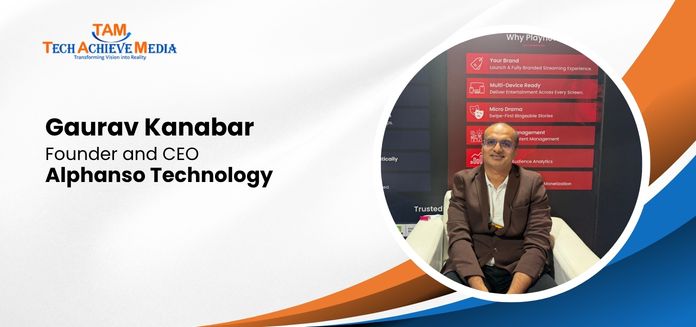
Technology is increasingly reshaping how enterprises operate, with artificial intelligence emerging as a key driver of business transformation, operational efficiency and innovation. However, as organisations move from AI experimentation to enterprise-wide adoption, questions around data ownership, sovereign AI and cybersecurity are gaining importance. At India Mobile Congress (IMC) 2026, Tech Achieve Media spoke with Gaurav Kanabar, Founder and CEO, Alphanso Technology, about the company’s focus on sovereign AI, its approach to building India-owned technology stacks, and how AI agents are helping businesses address real-world operational challenges. He also shared his views on the need for enterprises to accelerate AI adoption and build secure, scalable AI capabilities.
TAM: Can you tell us a little about Alphanso Technology and the work the company is doing?
Gaurav Kanabar: At Alphanso Technology, we work on artificial intelligence, particularly sovereign AI, with a focus on ensuring that India has ownership of its technology stack. We also work on AI model training, open-weight model training, and the intersection of AI and cybersecurity. As AI models become increasingly intelligent, we also need stronger cybersecurity capabilities to defend against potential threats. The more advanced AI becomes, the greater the need for AI-powered cyber defence. We are looking at this intersection to help enterprises build secure and resilient AI capabilities.
TAM: India is adopting AI at an unprecedented pace, with a large number of organisations experimenting with pilot projects. However, large-scale enterprise deployments remain relatively limited. What are the key challenges preventing this transition?
Gaurav Kanabar: One of the biggest challenges is enterprise adoption. Organisations need to change their mindset and understand how AI can be integrated into their existing business workflows. Every enterprise has different processes, and introducing a new technology into these workflows comes with a learning curve. When we approach an enterprise, the first step is to demonstrate the capabilities of the technology and explain how it can deliver measurable business benefits. We focus on showing how AI can improve the top line and bottom line of a business by automating repetitive manual tasks. It is not necessarily about replacing employees but about replacing the manual tasks they perform, allowing them to focus on more meaningful work.
TAM: Could you share some real-world enterprise use cases where Alphanso Technology is applying AI to solve business challenges?
Gaurav Kanabar: We are working on several industry-specific use cases. One example is a company in the crane rental business that operates around 150 cranes across different locations in India. The company was facing challenges in managing the mobilisation and utilisation of its cranes across locations. We are developing an AI-driven solution to streamline its operations and optimise crane utilisation, which currently stands at around 30 to 40 percent. Through AI-led optimisation, we expect the company to improve its operational efficiency and generate benefits for both its top line and bottom line.
Another use case is in the manufacturing sector. We are working with a company that manufactures diesel motors, with around 5,000 different motor variants. Each motor requires between 50 and 100 components. When the company receives an order for 1,000 motors, it needs to determine whether all the required components are available in its warehouse or whether additional procurement is necessary. We are developing an AI agent that can analyse the inventory, identify the components available and determine what needs to be ordered. This will help the manufacturer plan procurement better, manage customer expectations and meet delivery timelines.
TAM: Data silos remain a major obstacle to enterprise AI adoption, particularly when organisations have information spread across multiple systems and locations. How is Alphanso Technology addressing this challenge to make AI agents more effective?
Gaurav Kanabar: We train our AI agents to fetch information from different sources, clean and process the data, and make it understandable for both machines and humans. A significant part of this process involves converting unstructured data into structured data so that AI models can interpret and work with it effectively. We then train the AI model on top of this processed information. Once the initial data processing is completed, our AI agents can also understand incoming unstructured data, convert it into a structured format and use it for subsequent tasks. This helps enterprises address data fragmentation and make their information more accessible for AI-driven operations.
TAM: The AI market is becoming increasingly competitive, with several players offering enterprise AI solutions. What differentiates Alphanso Technology from other players in the market?
Gaurav Kanabar: Our key differentiator is that we work with an Indian technology stack and do not depend on foreign technologies. We deploy open-source AI agents on the enterprise’s own data infrastructure and GPUs. This means the models, technology stack and computing infrastructure can remain under the enterprise’s ownership and control. We are supporting the Make in India initiative through these efforts. Our approach ensures that Indian enterprise data remains within the organisation’s own infrastructure, including its factory premises, rather than depending on external technology environments.
TAM: Before we conclude, what would be your message to enterprises that are still evaluating their AI adoption strategies?
Gaurav Kanabar: AI is a great technology, and it is here to stay, just as software became an integral part of businesses in the 2000s. It is now about how quickly enterprises can adapt to this technology. AI models are becoming intelligent at a very fast pace, and organisations need to understand how they can leverage these developments. Enterprises that are able to adopt AI faster and integrate it effectively into their business operations will have an advantage. Those that do not adapt to this technology risk being left behind.