As organisations accelerate AI adoption, the gap between the returns they are achieving and their preparedness to manage the associated risks and complexities is widening, according to the Kyndryl Readiness Report 2026, unveiled recently. The report reveals that 60% of Indian business leaders report positive returns on their AI investments, an increase of three percentage points from 2025. However, average readiness to address external risks declined by eight percentage points to 27%, highlighting growing concerns around technology foundations, organisational transformation and risk management as AI adoption gathers momentum.
Indian organisations are making progress in moving AI beyond experimentation, with 85% deploying AI in workflows beyond pilot projects. Meanwhile, the share of organisations still in the experimentation stage has declined by 15 percentage points to 56%. However, translating successful pilots into enterprise-wide deployments remains a challenge. Around 70% of organisations report having more AI pilots than they can realistically scale, while 58% say innovation frequently stalls after the proof-of-concept stage. The findings also point to challenges in strategic alignment and investment decisions. Half of the organisations surveyed have significantly changed their AI strategy over the past year, while 31% have experienced an AI investment failure. Further, 37% report disagreements between their CHRO and CTO/CIO on AI strategy, underlining the importance of organisational alignment in driving AI-led transformation.
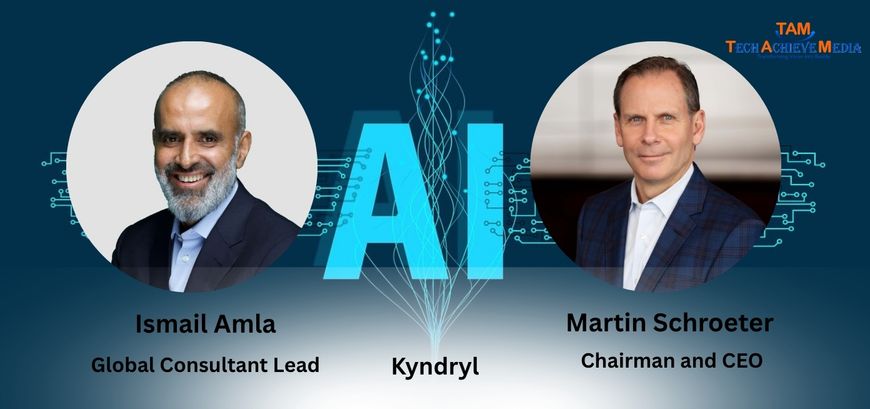
Tech Achieve Media spoke to Ismail Amla, Global Consultant Lead, Kyndryl, and Martin Schroeter, Chairman and CEO, Kyndryl, to understand what is preventing enterprises from scaling AI, how business leaders should measure the actual value of AI investments, and why people and organisational readiness remain central to successful AI transformation.
TAM: What breaks when organisations move from AI pilots to enterprise-scale deployment? And why do so many promising initiatives fail to deliver at scale?
Ismail Amla: I think what the data tells us from the report, and what our customers are also telling us, is that some of the fundamentals in a production environment are different from the requirements we have been accustomed to in the past. Of course, the requirements of being completely secure and ensuring transparency and auditability remain. However, they are harder to execute. One of the major stumbling blocks is whether our customers are ready and whether they have the infrastructure and technology in place to run an AI mission-critical system.
But the biggest stumbling block is not technology. It is about how work changes and whether the people working with these new systems are incentivised and trained in the right way. Do they understand what it means to work with agents? Are the goals being set still aligned with the intended purpose and not just the scope of the software? It is a combination of technology and people. As Martin mentioned earlier, we have always talked about people, processes and technology. Those fundamentals remain relevant, but the complexity is much greater now, with a significant human change management aspect layered on top.
TAM: There is considerable investment going into AI, but how should business leaders distinguish between AI adoption and actual business transformation? What metrics should they be measuring?
Martin Schroeter: Think about the massive pool of data we have from running the systems that we manage. Knowing what is out there and understanding the current state is important. But the really important data is about what our engineers are doing and what the outcomes of their actions are. When we look at whether AI is being used effectively and in the right way, we are essentially asking: Are we making better decisions? Are we learning more about what works and what does not work as we move forward? That is just one small example. For most of our customers, business cases are still largely driven by productivity. How can we save costs? How can we do something more efficiently? How can we deliver better services at a lower cost However, many customers are now beginning to attach growth aspirations to these productivity objectives.
Let me give you a general example. If I am a bank and I re-engineer my Know Your Customer (KYC) onboarding process, I can look at how much faster I can make it and how much more efficiently I can deliver it. Those are the right metrics to measure. But I am also beginning to recognise that if I make it easier for customers to do business with me, there could be a growth opportunity attached to that as well. So, for us, the key questions are: Are we making better decisions? Are we delivering better services? Are customers seeing and experiencing the difference? Are we helping them save money? For our customer base, business cases are still largely driven by productivity, but many are now also incorporating an aspiration for growth.