The rapid adoption of artificial intelligence is beginning to reshape how consumers discover products, how marketers build campaigns and how brands engage with shoppers, with agentic AI emerging as a significant force in the next phase of digital commerce. At the Criteo Commerce Forum India 2026, the company’s leadership , said the industry is entering a period of technology-driven transformation where the pace of change is unprecedented and commerce AI will increasingly complement existing shopping behaviour rather than replace traditional channels.
Also read: AI Playbook for Modern Retailers: Medhavi Singh, Country Head, Criteo India
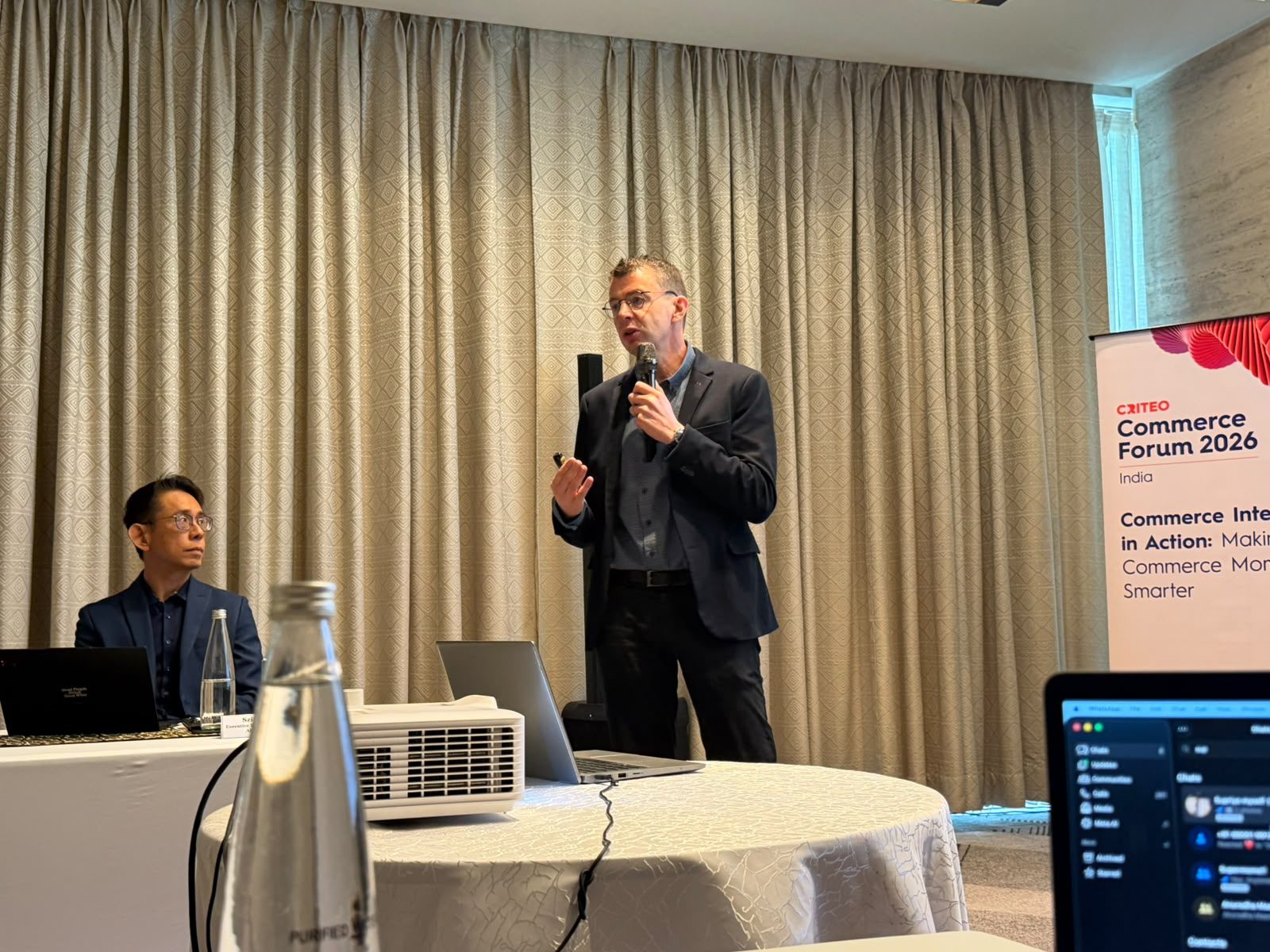
The event opened with welcome remarks from Szi-Wei Lo, Executive Managing Director, Criteo APAC, who spoke about India’s fast-evolving digital commerce landscape and Criteo’s long-term commitment to the market. Held at The Westin Gurgaon under the theme ‘Commerce Intelligence in Action: Making Every Commerce Moment Smarter’, the fourth annual Criteo Commerce Forum brought together more than 200 senior marketing and commerce professionals to examine the impact of AI, commerce intelligence and trusted data on India’s increasingly fragmented omnichannel ecosystem.
Diarmuid Gill, Chief Technology Officer, Criteo said Criteo’s experience with AI stretches back more than two decades, but the emergence of generative and agentic AI is taking the technology into a fundamentally different phase: “Last year was a very notable event for Criteo. We celebrated our 20th anniversary. So, from our earliest days, we’ve been using AI. So, all of this graded data, using machine learning and different advanced artificial intelligence to be able to deliver performance for us and for our clients. Now, in the last few years, there’s been this revolution of agentic AI, taking it to another level. When ChatGPT was launched, it transformed the entire ecosystem.”
Also read: Will Personal AI Agents Empower Consumers or Sway Them? Todd Parsons of Criteo Answers
Describing the current period as the beginning of what he called the Fourth Industrial Revolution, Gill said AI would have an impact comparable to previous technological shifts, but with one major difference, the speed at which change is taking place: “We say we are at the start of the Fourth Industrial Revolution. The first came through steam power in the 1700s. The second came with the advent of electricity and the internal combustion engine. The third came with the rise of computing, leading all the way up to the internet. And the fourth is the AI revolution. Like all the revolutions before it, this one is going to completely transform every part of society. There will be a before and an after, and nothing will ever be the same again. The difference between this revolution and all the others is the pace of change. Whereas before, change happened over years and months, now it is happening in weeks.”
India emerges as a key market for commerce AI
According to Gill, India is particularly well positioned to benefit from the AI-led transformation, with businesses and consumers rapidly experimenting with AI tools: “India is a rapidly advancing society, and technology is one of the areas where this is most evident. We see that the Indian ecosystem is really embracing this new revolution. More than 80% of businesses, that’s four out of five businesses, are looking at how they can use agentic AI.”
He pointed to the rapid growth of ChatGPT adoption in India as another indication of the market’s appetite for AI-led experiences: “India has now become the second-largest market for ChatGPT, and it is expected to become the largest market as well. It is incredible to see the rapid adoption of this technology. We are also seeing Indian consumers increasingly use not just ChatGPT, but Claude, Gemini and Copilot, along with other AI tools, to help inform how they shop online.”
Also read: How Criteo and Swiggy’s Offsite Retail Media Helped Kellog’s
Gill also highlighted the growing role of AI in product discovery. He said nearly half of consumers are already using AI for shopping, while shoppers using these tools are increasingly looking beyond the product they initially searched for: “Looking at some of the deeper statistics, we see that almost half of people are now using AI for shopping. I know personally, I’ve used it several times this week.”
He added: “56% of shoppers using these tools also want recommendations for similar or complementary products. So, if I buy a bike, what else might I need with it? Cycling equipment, a helmet, and other accessories that go along with it.” Rather than viewing AI-enabled shopping as a replacement for existing commerce channels, Gill sees it as an additional layer that can expand the overall opportunity for brands and retailers: “96%, and this is particularly interesting. There is a lot of discussion about how commerce AI might take over the world, but we see it as an incremental opportunity that will complement the way people already shop. It won’t replace existing shopping behaviours. When e-commerce first took off, people predicted it would be the end of brick-and-mortar and high-street stores. Instead, what we saw was that e-commerce helped grow the overall pie. We believe commerce AI will do the same.”
From smarter advertising to intelligent decision-making Gill outlined three areas where Criteo sees commerce AI making a significant impact: improving technology, making marketing workflows more efficient and creating richer consumer experiences: “So, today, I’m going to take you through three different areas where we see commerce AI changing how things work. First, how we think it is making technology smarter, and how this new generation of agentic functionality is helping to elevate the products we build.”
The second area, he said, involves removing repetitive manual work from advertising and marketing operations: “Second, how we work on a daily basis. One of the things about ad technology is that there is a lot of manual work involved including creating campaigns, setting targets, generating reports and doing all these kinds of tasks. We believe, and, in fact, we don’t just believe it; we see it, that all of these tools are helping to really accelerate the way we work.”
The third and potentially most significant area is the consumer experience itself: “And finally, an area which I think is one of the most exciting: how quickly we see these impacting how people are using shopping online and how it’s elevating the consumer experience. Criteo’s position in this emerging ecosystem is supported by its scale of commerce data and relationships,” Gill said. The company has more than 17,000 direct advertiser relationships and thousands of publisher relationships, giving it visibility across different stages of the digital commerce journey.
He said this creates a feedback loop spanning retailer websites, browsing behaviour, advertising exposure, clicks and transactions: “We know that high-quality users look at high-quality content. So, this gives us the full loop, where we can see what happens on retailer websites, what people do as they browse the web, what ads they see, which ads they click on, which ads they don’t, and then what transactions they complete as a result.”
AI moves from prediction to agentic execution
Gill explained that Criteo’s AI journey has evolved from traditional machine learning and deep learning towards foundational models and agentic systems capable of supporting more complex commerce decisions: “Where this gets interesting, from a shopping point of view, is that you can then draw connections between shoppers, products and content, and have AI determine what makes the most sense to show to a particular person, in a given place, at a given time.” Gill said the technology can identify relationships between products that may not be obvious at first glance, helping marketers understand purchasing patterns and improve recommendations.
Criteo’s scale of data also enables its models to continually learn from consumer interactions: “As a user goes through their shopping experience, they land on a retailer’s website and search for a product. They look at the product detail page. They add some things to their basket, purchase some, and decide not to buy others. We’re able to use this information to continually train our models and refine them to deliver the most accurate predictions and recommendations.”
Gill said this intelligence can translate into measurable improvements for advertisers, including stronger prospecting, click-through rates and conversions: “Using this technology, we’re seeing 37% more new customers from prospecting audiences, a 20% increase in click-through rates, more conversions and, most importantly, more revenue, which is ultimately why our clients do business with us: because they get better results from us.”
MCP becomes the ‘plumbing’ for the agentic ecosystem
A key component of Criteo’s strategy is the use of Model Context Protocol (MCP) to connect AI agents with the company’s commerce intelligence capabilities. Gill described MCP as the infrastructure that allows agents to discover and interact with different functionality across systems: “This is a technology defined by Anthropic, and it serves as the plumbing that interconnects the agentic world. Layered on top of APIs, it provides a way for agents to discover what functionality is available. So, as you interconnect your systems, MCP provides the plumbing that connects everything together.”
Criteo has invested in making its forecasting, prediction and recommendation capabilities available through MCP endpoints, enabling customers to access them through different AI interfaces: “With Criteo, we’ve invested heavily in taking all of the rich functionality I mentioned earlier—the forecasting, prediction and recommendations, and making it available through MCP endpoints. This allows our clients to use these capabilities through tools such as Claude, Gemini and Copilot, as well as within their own tools. It makes the integration with Criteo’s systems much easier, while also making the experience incredibly rich and powerful.”
The implications extend beyond simply generating reports. Gill demonstrated how users can interact with Criteo’s systems using natural language to understand campaign performance, identify relevant audiences and make recommendations: “And what’s super interesting is that this accelerates some of the most menial and repetitive tasks that people do on a daily basis. With the power of agents, you’re able to chain all of these events together and create skills that can then be used to build automations to carry out all of these actions on your behalf. This gives you greater efficiency and frees you up to focus on much more interesting work.”
Gill sees this as an opportunity to shift marketing teams towards higher-value work rather than as a threat to existing roles: “There is often a lot of talk about the agentic world, and some people see it as a threat. I see it very much as an opportunity, to give time back to our teams so they can use that time to work on higher-value tasks.”
He said natural-language interfaces are also lowering the barrier to using sophisticated marketing technology: “The ability to streamline that end-to-end orchestration, from setup to optimisation, and do it through a human interface. As you saw in the example, people were able to use natural language to say, “I want to create a campaign. I want to target this product towards a particular audience.” All of this is now feasible without a computer science degree.”
Generative AI brings new possibilities for advertising creatives
Beyond campaign management and audience selection, Criteo is also using generative AI to change how advertising creatives are developed. Gill said the company processes billions of products every day and maintains a catalogue of more than 20 billion products: “We ingest billions of products from our clients every single day. We have more than 20 billion products in our product catalogue, each with a different set of images. Using those images and generative AI, we’re able to create rich, engaging video experiences. We’re able to enhance images and take a text description and generate rich images from it, making the overall experience much more engaging.”
The next stage, however, is not simply about improving the advertisement itself, but making the advertisement interactive: “In fact, in some cases, we’re even able to enable users to interact with the advertisement, allowing them to query it and ask questions about the product or offer.”
Towards conversational commerce experiences
Gill said AI is also creating the possibility of more conversational shopping experiences, where advertisements can become an interface through which consumers ask questions and explore products: “We have a live demo, a prototype that is currently running with a client in Europe, where we have a conversational ad unit. Users can type into the ad, look at the product and ask for more details or information about it, or even ask for different products.”
He compared the experience to interacting with a salesperson in a physical store, where shoppers can ask questions and receive recommendations rather than simply being presented with products: “So, it’s very much driven by the context of the page it’s on, with the ability to tailor the experience. It’s similar to what you would do when you go into a store and ask a salesperson or sales assistant about a particular product, ask for recommendations, or enquire about the returns policy and other details. All of this creates a very, very engaging experience.”
For Gill, the combination of AI and Criteo’s commerce data could help bring some of that physical retail experience into digital commerce: “So, one of the best experiences you can have as a shopper is when you walk into a store and a sales assistant comes up to you. They’re not interested in pushing a product down your throat; they just want to give you the best experience. They want to answer your questions and act as an advisor. That is now finally possible using these kinds of systems.”
Fresh commerce data becomes critical for AI-led shopping
Gill also highlighted a key limitation of large language models in commerce: the dynamic nature of product information. Prices, inventory, promotions and product availability can change rapidly, making static information insufficient for commerce decisions: “One of the things that’s a limitation of an LLM, and we keep hearing about every time there’s a new model released, an LLM is trained by scraping all of the data that it can have access to. But the second that it’s trained, it becomes out of date. It becomes out of date because product information is very dynamic. Prices change all the time. There’s flash sales, there’s stock ruptures, there’s new models that come out, and the LLM does not know about those.”
Criteo’s proposition, Gill said, is to provide the continuously refreshed commerce intelligence that AI systems need to make relevant shopping recommendations: “Since Criteo ingests more than 20 billion products every single day, we always have the most up-to-date and richest product information. So, when an LLM calls Criteo, we’re able to provide exactly the most current information”
Marc Fischli, Executive Managing Director, International Markets, Criteo, shared Criteo’s evolution into the commerce intelligence platform and how AI is reshaping product discovery for brands. He also highlighted that AI is growing the ecommerce pie, enabling commerce to evolve beyond retail media and targeting into truly cross-channel and full-funnel experiences: “Our new mission is to power intelligent commerce wherever it happens. Commerce remains central to what we do, but commerce intelligence that drives better and broader outcomes for our clients and the industry is becoming the heart of what we do. As AI creates new opportunities and additional channels, we believe it will grow the commerce pie rather than replace existing ones. The linear funnel no longer reflects how consumers shop today; people interact with brands across multiple touchpoints and channels in parallel. That is why we believe the future is very much full-funnel and cross-channel, with integrated campaigns that reflect the way shoppers actually discover, evaluate and purchase products.”
The forum also showcased real-world examples of how Criteo’s commerce intelligence and AI-powered decisioning are translating into measurable outcomes for brands. In an interactive session with Medhavi Singh, Country Head at Criteo India and Driv Vohra, Head of Digital Marketing, Mars Snacking, a Kellogg’s case study was demonstrated to discuss how Criteo’s cross-channel, full-funnel approach helped drive scaled reach and new-to-brand acquisition, delivering 2.1–2.3 million average weekly reach on OTT and 97% new-to-brand buyers. Vohra commented, “Commerce signals are most valuable when they help move beyond audience identification to measurable new-to-brand growth. In our campaign, Criteo used transactional signals to identify relevant breakfast-cereal audiences, build reach through OTT, and extend engagement across Meta and the open web. This cross-channel, full-funnel approach helped connect awareness and consideration with conversion and acquire new customers.”