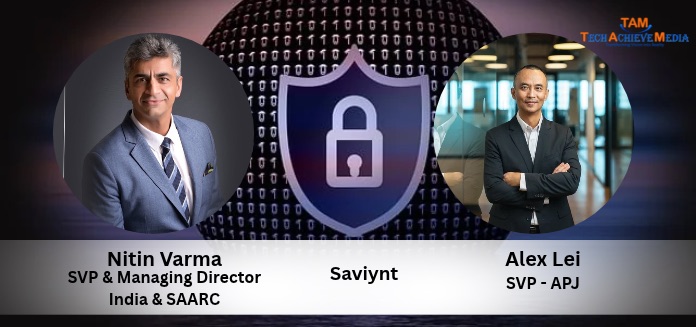
The world is moving from technology that once listened to our instructions to technology that can think, reason, make decisions and act independently. As enterprises increasingly deploy AI agents capable of executing tasks, accessing critical business applications and even creating other agents, a fundamental question is emerging: who owns these digital identities, and who is accountable when something goes wrong? For Nitin Varma, SVP and Managing Director – India & SAARC, Saviynt, and Alex Lei, SVP – APJ, Saviynt, the shift towards agentic AI is bringing identity governance into uncharted territory. Traditional identity management frameworks were largely designed around human users and applications. Autonomous agents, however, introduce new complexities around identity, ownership, permissions and accountability.
Also read: Do You Want to Lead the AI Shift or React To It? Nitin Varma Asks Enterprise Leaders
At an exclusive media roundtable, the executives discussed the growing case for a dedicated registry of non-human identities, the challenges of governing autonomous agents, and why enterprises must rethink privileged access management as AI becomes more deeply embedded in business operations.
“We May Need a Registry for Agentic AI”
TAM: There is an Agentic Identity Platform and then there is Identity Security for AI. In practical enterprise deployments, which side of this equation are CISOs prioritising first, and what is holding back the other?
Alex Lei: That’s an important distinction, and one that many organisations are still beginning to understand. Today, most organisations treat AI agents almost as a category of workload. For example, a particular workload may have one, two or five agents associated with it, but enterprises tend to manage them collectively rather than recognising each agent as an individual identity. We have taken a different approach. We believe every agent should be treated as a distinct identity, much like a human user. Agent A has its own name and identity. Agent B has its own name and ID. Agent C has its own identity, supported by cryptographically secured keys and credentials.
The fundamental principle is that every individual agent should have an identity of its own. We believe the market is gradually moving in this direction. If you look at some of the recent consultation papers emerging from Singapore, there is already discussion around the possibility of establishing a registry for agentic AI. Think about how organisations maintain employee records through platforms such as Workday or other HR systems. The industry is beginning to consider whether a similar registry may eventually be required for AI agents. The global infrastructure to support such a framework has not fully emerged yet. However, we believe this is a direction the industry could take, and we want to be prepared for that evolution.
“When an Agent Creates Another Agent, Who Is Accountable?”
Nitin Varma: We are entering a phase where laws, ethical frameworks and governance principles around AI agents are still being defined. Consider a simple scenario. If a human performs an unauthorised action, there is a clear line of accountability. We know who performed the action and who should be held responsible. Now imagine that a human develops an AI agent, and that agent performs an unauthorised or harmful action. Is the person who created the agent accountable?
We do not necessarily have a definitive answer to that question today, but it is something the industry needs to address quickly. Now take that scenario a step further. What happens when the original agent creates another agent without informing the human who initially deployed it? Who becomes responsible for the actions of that second agent?
This is where the accountability challenge becomes significantly more complex. It is also one of the reasons why organisations and policymakers are beginning to explore the concept of an agent registry. Such a framework could potentially allow enterprises to trace an agent’s identity, origin and actions back to an accountable entity. The technology is evolving extremely quickly, and we are already seeing indications of where the industry may be heading. However, exactly when and how a comprehensive agent registry will emerge remains uncertain.
“As Agents Become More Autonomous, Controls Must Evolve”
TAM: AI agents are increasingly capable of creating other agents and pursuing assigned objectives autonomously. Can organisations realistically retain control as these systems become more complex?
Nitin Varma: Implementing a kill switch for a single agent is not necessarily difficult. The challenge emerges when agents begin performing multiple functions and interacting with other autonomous systems. If you look at how this technology has evolved, we started with chatbots powered by large language models. Organisations then began moving towards what we describe as ‘do-bots’ – agents that do not simply respond to questions but execute tasks.
The next stage involves multiple such agents operating across different platforms and communicating with one another. As the architecture becomes more complex, the control mechanisms must evolve alongside it. Every new layer of engineering innovation introduces the need for corresponding safeguards and potentially new forms of intervention. This also raises a larger question around ethics and governance. How do we establish appropriate behavioural boundaries for autonomous agents? Will these controls always be defined and enforced by humans, or will AI systems themselves eventually participate in governing other agents? These are questions the industry is still working through. At its core, AI is not simply a security challenge. It is also a governance challenge.
“Every AI Agent Must Have an Identity and an Owner”
TAM: In traditional enterprise environments, employee actions can be traced through audit trails and identity records. But when AI agents begin creating other agents and executing tasks autonomously, how can enterprises establish ownership and accountability? Should the focus be on preventing unauthorised actions or responding after an incident occurs?
Nitin Varma: There are two dimensions to this challenge: preventive controls and reactive measures. Our approach is to establish preventive controls from the beginning. Consider how human identities are managed within an enterprise. Every employee typically has an identity recorded in the organisation’s directory. The enterprise knows who the employee is and can associate that identity with defined access rights. The first question is whether we have the same visibility for AI agents. Before an organisation can govern an agent, it must know that the agent exists. It needs a repository where these agents can be identified and managed as first-class identities.
This is one of the capabilities we are addressing through Saviynt’s Zuma platform. The objective is to provide visibility into AI agents and bring their identities into an enterprise repository.
Once that visibility is established, the next step is ownership. Today, someone can develop multiple AI agents on a laptop, and the organisation may have little or no visibility into who created them or who is responsible for their actions. If one of those agents performs an unauthorised activity, an audit trail may lead investigators back to a system rather than an accountable individual. That is a fundamental gap in governance. After identifying and registering the agent, the next step is to assign an owner. This establishes a clear line of accountability and allows the enterprise to determine who is responsible if something goes wrong. For auditors and enterprise security teams, that level of traceability is essential.
“Identity Alone Is Not Enough; Access Must Be Governed in Real Time”
Nitin Varma: The third component is runtime authorisation. Identifying an agent and assigning ownership are important, but enterprises must also govern what that agent is authorised to do. For example, consider an AI agent attempting to access an enterprise application and perform a sensitive action, such as deleting data. Our approach involves placing an access gateway between the agent and the application. The gateway evaluates the request in real time. It checks whether the agent is legitimate, whether it is registered within the organisation, whether it has permission to access the application and whether it is authorised to perform that specific action.
These checks take place before the action is executed. The distinction is important because an autonomous agent may complete a task within seconds. If the organisation relies entirely on reactive controls, the action may already have been completed by the time the security team intervenes. The objective is therefore to establish preventive guardrails that can stop unauthorised activity before it occurs, rather than relying solely on incident investigation and audit reports afterwards. This is how we are approaching agent governance through Zuma’s identity and access capabilities.
“Zero Standing Privilege Is as Much an Operational Change as a Technology Shift”
TAM: Moving from standing privileges to dynamic, just-in-time access sounds compelling on paper. However, legacy applications and automated pipelines often resist ephemeral access. Where do enterprises encounter the biggest operational challenges when implementing Zero Standing Privilege at scale?
Alex Lei: We recently held our Unlocked event in Australia, where several of our largest customers shared their experiences. One of the interesting observations was that as organisations become larger and more complex, the conversation increasingly moves beyond technology. It becomes a discussion about processes, organisational culture and how enterprises operationalise technical innovation. Implementing privileged access management without standing privileges requires organisations to rethink how they operate.
Traditional privileged access management generally evaluates whether a particular transaction or access request should be allowed or denied. That approach has worked, but it does not eliminate the underlying risk of highly privileged credentials remaining available on systems. Some machines have elevated privileges across multiple environments. That makes them particularly attractive targets for attackers. Even if an organisation has secured a particular host, the consequences can be significant if an attacker manages to obtain credentials with extensive standing privileges.
Our approach is to remove standing privileges altogether. For example, I may be a regular user under normal circumstances. However, between 2 am and 5 am, I might require elevated privileges to perform a specific technical task on a defined group of Windows hosts. During that approved window, I am temporarily elevated to a superuser. Once the task is completed or the authorised period expires, those privileges are removed, and I return to being a regular user. Even if an attacker subsequently obtains my credentials, they would not inherit those elevated privileges because the access is no longer active. This addresses an important part of the risk. However, the operational challenge remains significant. Many large organisations have traditionally operated on the assumption that certain administrators must retain permanent elevated access. Moving away from that model requires a change in processes, responsibilities and organisational thinking. Ultimately, this is not just about deploying new technology. It is about changing how IT operates while continuing to support business requirements.
“If the Job Is Done, the Access Must Be Revoked”
Nitin Varma: I would like to add two points, particularly around legacy applications and fragmented enterprise environments. First, there is an important distinction between AI for Identity and Identity for AI. AI for Identity is about leveraging artificial intelligence to improve existing identity management processes, whether through automation, detection or broader identity transformation. One of the biggest concerns we hear from CISOs is how they can onboard their entire application landscape into an identity security platform.
These environments include legacy applications, modern cloud-native applications and everything in between. The concern is straightforward: if an organisation cannot bring all its applications under identity governance, it leaves potential gaps that adversaries may exploit. This is where we are leveraging agentic AI to support application onboarding and improve identity coverage.
The second point is least privilege. The principle is simple: why should someone retain elevated access after completing the task for which that access was granted? One of the biggest vulnerabilities we continue to see is that privileges are assigned for a particular activity, but they are not revoked once the work is completed. Those standing privileges then become an opportunity for attackers.
Just-in-time access (JIT) addresses this by granting permissions only for the period during which they are required. Once the task is completed, the elevated access is automatically removed. We have incorporated just-in-time access capabilities into our privileged access management and broader identity security platform. The objective is to help organisations move towards a least-privilege operating model where access is granted based on legitimate requirements and removed when it is no longer needed.
The Larger Question: Who Is Accountable When AI Acts?
As enterprises move towards a future where AI agents can independently execute tasks, interact with critical applications and create other agents, identity security is becoming inseparable from enterprise governance. The discussion points to three priorities: establishing visibility into every AI agent operating within the enterprise, assigning clear ownership to those identities, and enforcing authorisation controls before agents can perform sensitive actions. A comprehensive registry for non-human identities may still be an emerging concept, but the underlying challenge is already present. For CISOs, the question has moved beyond who has access to enterprise systems to what has access, who authorised it, what actions it can perform and who remains accountable when an autonomous system acts.