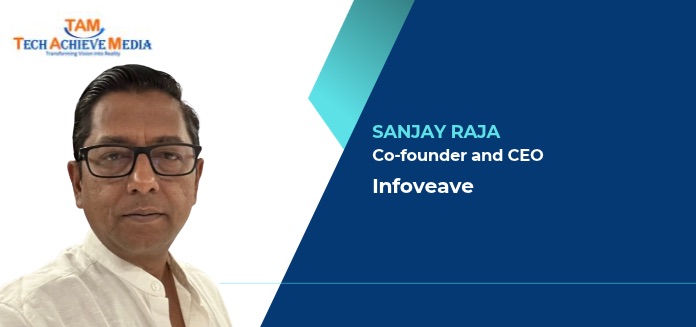
The enterprise technology landscape is moving beyond traditional Business Intelligence (BI), with organisations increasingly looking to convert fragmented data into actionable business decisions. As Generative AI and Agentic AI reshape enterprise operations, the focus is shifting towards trusted data, contextual intelligence and decision-making capabilities rather than dashboards and analytics alone. For Sanjay Raja, Co-founder and CEO, Infoveave, the next phase of enterprise intelligence will be defined by the ability to connect data with business context and translate insights into action. In this interaction with Tech Achieve Media (TAM), Raja discusses the limitations of traditional BI, the role of semantic data layers in enterprise AI, the need for governed intelligence and Infoveave’s journey from a services-led business to a global IP-driven enterprise technology company
TAM: Why has the industry been so slow to evolve past data visualisation, and what fundamentally breaks when an enterprise tries to scale traditional BI into the AI era?
Sanjay Raja: The industry has spent the last two decades getting very good at collecting, processing and visualising data. However, visualisation was never the end goal; better decision-making was. Traditional Business Intelligence evolved primarily around helping businesses understand what had happened through dashboards, reports and historical analysis. While this was a significant advancement, it left a critical gap between generating insights and translating those insights into timely business action.
The challenge becomes more pronounced as enterprises scale. Data is distributed across multiple systems, business definitions vary across departments and different teams often arrive at different interpretations of the same metric. Traditional BI can present this information, but it does not necessarily establish a shared understanding of what it means in the context of a business decision.
When AI is introduced into this environment, these underlying inconsistencies become even more problematic. AI can accelerate analysis, but if the data is fragmented, poorly governed or lacks business context, it can also accelerate incorrect conclusions. The fundamental shift we need is from reporting on data to creating an intelligent, connected environment where data, business context and decision-making come together. This is precisely the space Unified Decision Intelligence addresses. At Infoveave, we believe enterprise intelligence must move organisations from raw data to clear understanding and from understanding to immediate action / next best action.
TAM: When you talk to CIOs and CDOs today, are they suffering from a lack of data, or is the core enterprise crisis actually decision paralysis? Where does the traditional data stack fail right at the moment a high-stakes decision needs to be made?
Sanjay Raja: In most mature enterprises, the problem is certainly not a lack of data. Organisations today have more data than they have ever had, generated through ERP systems, CRM platforms, operational applications, customer interactions and an expanding digital ecosystem. Yet, having more data has not necessarily translated into better or faster decisions. In fact, it has often created another challenge: decision paralysis.
CIOs and CDOs are increasingly dealing with a disconnect between data availability and decision readiness. A business leader may have access to multiple dashboards, but when a critical decision needs to be made, the questions are much more fundamental. Are these numbers reliable? Are different departments working with the same definitions? What is driving the deviation? What are the implications of acting now versus waiting?
Traditional data stacks are largely designed to move, store, process and present information. They are not inherently designed to connect enterprise data with business meaning, operational context and the decision at hand. This often forces decision-makers to go back to analysts, reconcile conflicting reports and seek explanations across departments.
That is where the traditional stack falls short. The missing link is a unified intelligence layer that brings together trusted data, contextual understanding and analytical capabilities.
Infoveave aims to bridge this gap. We want enterprises to spend less time validating information and more time using it to make informed decisions. Ultimately, the competitive advantage will not belong to organisations that simply have the most data, but to those that can convert trusted data into decisive action.
TAM: How does Fovea ensure that Agentic AI doesn’t just generate plausible-sounding hallucinations, but reasons strictly on certified enterprise metrics and context?
Sanjay Raja: One of the biggest concerns with introducing Generative AI into enterprise environments is the distinction between a response that sounds convincing and one that is actually correct. In a consumer application, an inaccurate response may be inconvenient. In an enterprise environment, it could influence financial commitments, operational decisions, customer relationships or regulatory outcomes. Therefore, enterprise AI cannot operate purely on the basis of a language model’s ability to generate responses.
Our approach with Fovea is built around the principle that AI must be grounded in the organisation’s trusted data and business knowledge. Fovea is not intended to function as an independent source of enterprise truth. It operates as an intelligence layer on top of foundational language models, drawing on the enterprise’s governed data environment, common data structures, semantic definitions and contextual business knowledge.
This distinction is important. When a user asks a question, the system needs to understand not just the words being used, but also what a particular metric means to that organisation, how it is defined, where the underlying data comes from and what business context is relevant.
The semantic layer plays a critical role here by establishing consistent definitions and relationships across enterprise data. This allows Fovea to interpret questions against established business logic rather than relying on assumptions generated by a language model. Equally important are governance, access controls and validation mechanisms. Enterprise AI must respect data permissions and distinguish between verified information and interpretation. No AI system can honestly promise zero hallucinations, but grounding AI in governed enterprise knowledge, rather than allowing it to rely on unconstrained model-generated assumptions, significantly reduces the risk. Our philosophy is simple: AI should make enterprise knowledge more accessible, not compromise the integrity of enterprise information.
TAM: As foundational models become commoditised, do you believe the true enterprise defensibility lies in owning the semantic data context layer rather than the model itself?
Sanjay Raja: Absolutely. Foundational models will continue to evolve, become more accessible and increasingly commoditised. We are already seeing a rapidly expanding ecosystem of models, each with different strengths in reasoning, language, speed and cost. While model capabilities are important, I believe the real enterprise differentiation will increasingly come from what sits around and above these models.
An enterprise’s competitive advantage is not simply in the technology it uses, but in the institutional knowledge it has accumulated over years: how it defines performance, how its business processes work, how different functions interact, what its operational priorities are and how it interprets information to make decisions. This knowledge is often fragmented across systems, departments, documents and individuals. A foundational model, irrespective of how powerful it is, does not automatically understand these organisational nuances.
The semantic and contextual layer becomes critical because it translates raw enterprise data into a consistent business language. It establishes relationships between data points, standardises business definitions and provides the context required to interpret information meaningfully.
At Infoveave, we have always believed that the value of enterprise intelligence lies in combining reliable data with business context. Our architecture is designed to create this unified environment, allowing organisations to leverage different underlying technologies without becoming dependent on a single model or data platform.
As models evolve, enterprises should be able to adopt better models without rebuilding their entire intelligence infrastructure. The enduring asset will be the governed semantic foundation and contextual business knowledge that make AI genuinely useful to the organisation. That, in my view, is where long-term defensibility will lie.
TAM: Infoveave’s lineage traces back to Noesys Software, founded in 2013 as a tech services and engineering firm. The traditional playbook for Indian tech has been services-first. What were the hardest cultural, architectural, and go-to-market shifts required to transition from a services mindset to building a globally competitive IP-led enterprise product?
Sanjay Raja: Our journey and growth from Noesys Software to Infoveave has been a continuous, ongoing process, in our effort to help our customers leverage technology effectively for business growth and efficiency. When we started Noesys in 2013, we were focused on software consulting, services and product engineering. Over time, working closely with businesses on their data, reporting and analytics requirements, we began identifying a recurring challenge. Enterprises were investing heavily in data infrastructure, but extracting meaningful intelligence from that infrastructure remained complex, fragmented and resource-intensive.
What started as a response to these recurring customer challenges gradually evolved into the idea behind Infoveave. We soft-launched the platform for testing in 2019, and what we had initially envisioned as a solution to specific business intelligence challenges developed into a much broader Unified Decision Intelligence platform.
The transition required changes across three dimensions.
Culturally, we had to build product ownership and think about the entire product lifecycle, including usability, scalability, reliability and continuous innovation. This meant developing a product mindset, focused on solving a common problem at scale. In services, customisation is often the answer. In product development, the challenge is to identify the underlying problem and build a repeatable solution that can serve multiple enterprises without compromising flexibility.
Architecturally, we had to think beyond individual implementations and build a scalable, configurable and platform-agnostic architecture. We needed to create a common foundation that could bring together disparate data environments, support enterprise governance and evolve continuously. This meant investing in reusable IP, product engineering, standardisation and long-term technology development rather than building isolated solutions.
From a go-to-market perspective, the shift was equally significant. Enterprise products require a clear market category, differentiated positioning, repeatable sales processes, customer success capabilities and sustained investment in product development. We also had to learn how to communicate the value of our technology to global enterprise decision-makers.
Our expansion through Infoveave Pty in Australia in 2023 was another important milestone in this journey. What remains at our core, despite the transition and our continuous efforts to adapt to evolving market needs and industry or technology trends, is our founding principles—agility, focus and care.
I believe India’s technology ecosystem has the engineering talent and entrepreneurial capability to create globally competitive enterprise products. However, the transition requires patience, conviction and a willingness to invest in IP even when the returns are not immediate. For us, Infoveave represents that long-term commitment to building technology from India for the world.
TAM: When selling enterprise-grade decision intelligence from Bengaluru and Melbourne into highly competitive global markets like the US and ANZ, how do you position an Indian-rooted product against entrenched US legacy tech giants? What is your competitive advantage?
Sanjay Raja: We do not believe that competing globally should be about positioning ourselves as an alternative to a particular geography or technology giant. It should be about demonstrating that we understand an enterprise problem deeply and have built a differentiated solution to address it.
The global enterprise technology market has several established players with significant market presence, large ecosystems and years of customer relationships. We respect that. However, we also believe that the nature of enterprise requirements is changing rapidly, particularly with the convergence of data engineering, analytics, AI and decision intelligence.
Many organisations are now looking beyond traditional BI and standalone analytics solutions. They want a unified environment that can connect data across platforms, establish trust, provide contextual intelligence and make insights accessible to business users. This is where we see a significant opportunity for Infoveave.
Our competitive advantage rests on six important pillars.
- First, a unified and platform-agnostic architecture, enterprises should not have to rebuild their data ecosystem or become locked into a particular technology platform to derive intelligence. Infoveave is designed to work across diverse enterprise environments and bring data into a common, governed structure. We are a unified platform, rather than a collection of technologies/products.
- Second, the combination of reliable data, trusted information and contextual intelligence. We have built our capabilities around the idea that better decisions require more than analytics. They require a dependable data foundation, consistent business definitions and the ability to interpret information in the context of organisational priorities.
- Third, our product-led approach to innovation. With Fovea, we are extending enterprise intelligence through AI-powered, conversational and contextual capabilities, making it easier for business users to interact with enterprise knowledge.
- Fourth, agility and faster time to value. Large technology vendors have extensive capabilities, but implementations can become expensive and complex, often requiring multiple products, specialists and consulting engagements.
- Fifth, business problem orientation, not just technology deployment. We don’t approach customers with a technology-first pitch. We start with the business problem. Whether it is improving dealer profitability, optimising retail operations, improving supply chain visibility or automating business processes, we focus on how data can improve actual business decisions and operational outcomes. That distinction is important. Customers don’t need another dashboard or another technology investment. They need better decisions and tangible business impact.
- Sixth, a different cost and partnership model. Being an Indian-rooted product company gives us access to strong engineering talent and a competitive product development cost structure. This allows us to offer enterprise-grade capabilities at a more competitive total cost of ownership, without compromising on the quality of engineering. Our presence across Bengaluru and Melbourne also gives us an important perspective on building for diverse global markets. Bengaluru provides access to a strong engineering and technology ecosystem, while our Australian presence strengthens our engagement with international customers and markets.
We see our Indian roots as an advantage, not a limitation. India’s technology ecosystem has demonstrated its ability to build sophisticated products for global markets. What ultimately matters is product depth, enterprise readiness, customer trust and the ability to deliver measurable business value. Our ambition is not simply to compete in the existing BI market, but to help shape the next category of enterprise technology: Unified Decision Intelligence. We believe the opportunity is global and Infoveave is building for that future.