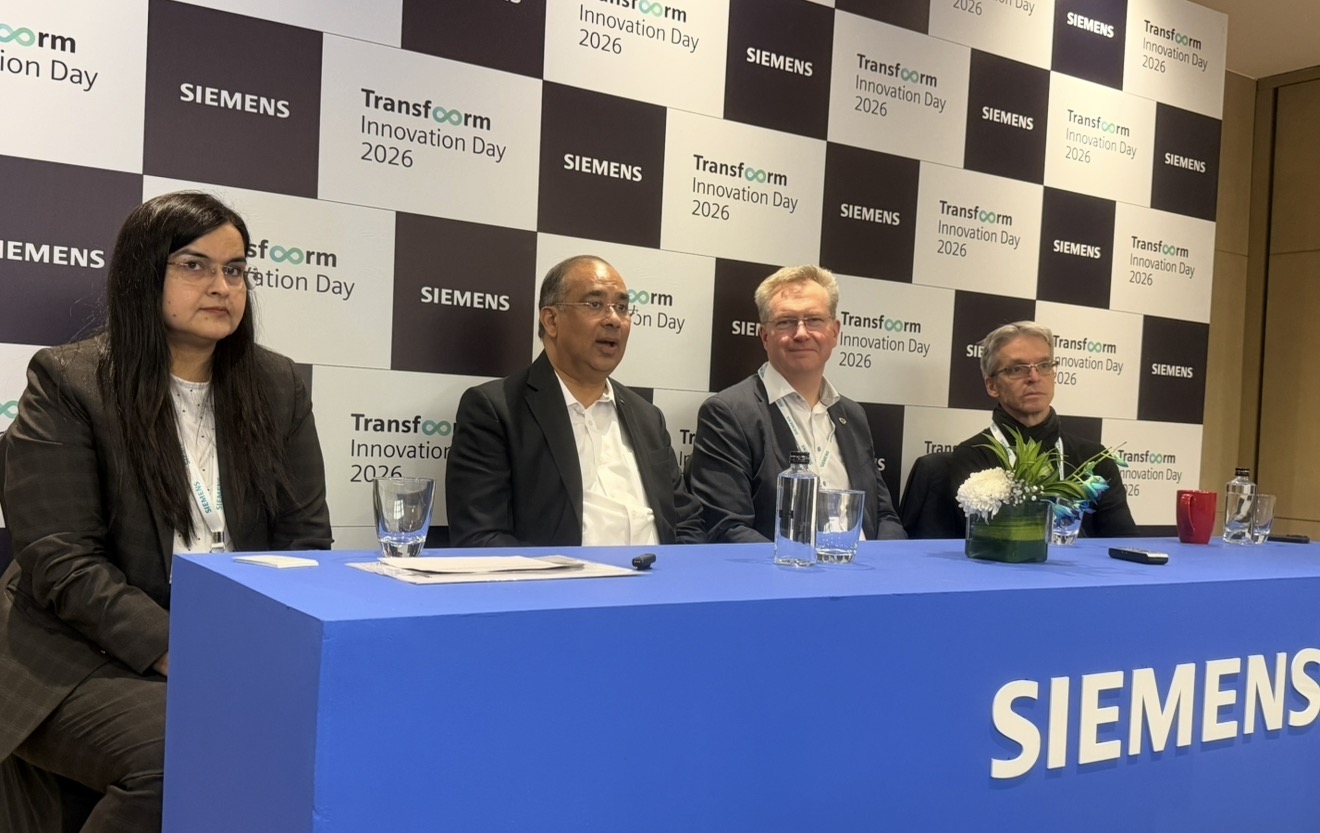
At a time when manufacturers are looking to move AI beyond experimentation and into real-world operations, Siemens is betting on industrial AI agents that can take on engineering tasks, improve productivity and help address the industry’s growing skills gap. The Eigen Engineering Agent, launched in India at the 7th Transform – Siemens India Innovation Day 2026 in New Delhi, is designed to execute automation engineering tasks, including PLC coding, Human-Machine Interface (HMI) visualisation and device configuration. Siemens says the agent has already been piloted with more than 16 customers in India.
Sunil Mathur, Managing Director and Chief Executive Officer, Siemens Limited, said, “India’s next manufacturing leap will be driven by productivity and quality, not just cost. For that, automation must reach the entire value chain, especially small and medium enterprises The Eigen Engineering Agent makes this possible. It helps lean engineering teams deliver complex automation projects faster, get them right the first time and bridge skill aaos. This is how industrial Al moves from experimentation to everyday operations on the shop floor.”
Also read: AI Models and the Future of Mathematics and Science
The launch comes amid a wider industry challenge, with many AI initiatives struggling to move from proof-of-concept to scaled deployment. However, Siemens believes industrial AI tools built around specific engineering needs, existing workflows and measurable productivity gains can accelerate adoption. In an interaction with the media alongside Transform – Siemens India Innovation Day 2026, Scot Gardner, Executive Vice President, Digital Industries, Siemens AG, discussed the commercial potential of Eigen, its relevance for India’s manufacturing sector, adoption among MSMEs, the need for deterministic AI in industrial environments and the challenges of scaling AI beyond pilots.
Gardner believes Eigen is addressing a practical engineering requirement rather than offering AI for experimentation alone. He also highlighted the importance of embedding industrial knowledge and safeguards into AI systems, particularly in environments where safety, precision and repeatability cannot be compromised.
TAM: AI adoption across industries has largely remained at the pilot stage, with only a fraction of organisations moving to large-scale deployment. Siemens has announced that Eigen has been piloted with more than 16 customers in India. What will help Eigen move beyond pilots and scale across industrial environments?
Scot Gardner: I think you’ve accurately described AI in the market. There are probably more AI pilots out there than in the entire airline industry. But Eigen is an agent that solves a very real engineering task for machine builders, production line manufacturers and companies involved in industrial discrete manufacturing. We are seeing a very fast ramp-up and adoption, and it is not just about pilots. These are deployments in production environments. Eigen has been constructed in a way that allows it to scale because it addresses a universal need.
The challenges it addresses are repetitive engineering tasks and, increasingly, the shortage of skilled professionals. We are seeing fewer people who are familiar with the complexities of engineering tools and systems. Eigen can help democratise engineering by enabling people who may not be deeply familiar with engineering to carry out tasks more effectively. The ease of use, the productivity impact and its seamless deployment within the TIA Portal environment are important factors that will help drive adoption. Eigen was launched in India today, so the 16 customers are pilot customers here. However, Eigen was launched earlier in other regions, and it is, as far as I remember, the fastest-growing SaaS service we have ever built at Siemens. It is scaling faster than anything else we have built, and those deployments are in production.
TAM: India has a large base of SMEs and MSMEs that remain cost-conscious and continue to operate with legacy infrastructure. Do you see these factors becoming barriers to the adoption of Eigen?
Scot Gardner: If there is a challenge, it is that some companies may not be using engineering tools today and will need to bring themselves up to using them. However, SMEs and MSMEs have to ask themselves whether they will remain competitive if they continue to rely on labour to address these challenges. The productivity advantage we are seeing with industrial AI is significant. We are not talking about single-digit improvements. We are talking about productivity gains of 20-30%, and in some cases, even up to 60%. We see that in some of the major deployments. The question businesses need to ask is whether they can remain competitive. Democratisation will happen across the market, and companies will have to make a choice.
It is important to note that Eigen works within the established TIA Portal portfolio, which is the world’s leading engineering system. Customers who are already configuring Siemens devices using TIA Portal can access Eigen through a subscription without having to buy an entirely new system. For customers who are not yet using TIA Portal, Eigen makes the engineering toolset an even more compelling proposition, as it can significantly improve overall performance and productivity.
TAM: Industrial AI is increasingly being used to automate engineering workflows. However, in manufacturing, precision, safety and repeatability are critical. How important is deterministic AI in industrial applications?
Scot Gardner: Anyone who has used ChatGPT or any consumer AI tool knows that sometimes, when you ask the same question, you don’t get the same answer. In an industrial context, you cannot have that. It is a very bad day on the shop floor if you have machines that are dreaming or not producing the same result every time. The two core use cases are safety and precision, and you have to be deterministic. The reason we have our Eigen agents is that we use our knowledge and understanding of the industrial world built over the last 180 years. We embed that knowledge into the way we put harnesses around AI and generative AI so that machines don’t dream; they produce the same result every time, for every event.