
Account Aggregation is the foundational DPI data-sharing layer, following the footsteps of Aadhaar (Identity) and UPI (Payments). “We enabled the Account Aggregator framework. It has facilitated lending to the tune of ₹3.5 lakh crore in FY 2025-26 and has the potential to scale up manifold.” – Mr Sanjay Malhotra, Governor, Reserve Bank of India. In the 5 years since launch (September 2021), AA has scaled significantly across the financial sector straddling lending, Insurance, Stock brokerages and Wealth management.
Table below brings out the growth of AA over past 4 years.
| Jun-22 | Jun-26 | |
| Cumulative Number of accounts enabled on AA (millions) | 310 | 2,887.0 |
| Cumulative Number of accounts linked on AA (millions) | 0.82 | 314.5 |
| Cumulative Number of consents raised on AA (millions) | NA | 1,972.1 |
| Cumulative Number of consents successfully fulfilled on AA (millions) | 0.76 | 493 |
| Number of live entities | 51 | 1,117 |
| Number of Live FIPs | 10 | 176 |
| Number of Live FIUs | 51 | 1,076 |
Source: Sahamati
We have only scratched the surface
Sole ownership – bank accounts, Depository accounts, Mutual fund folios etc, GSTN are have only been enabled thus far. With such a limited set, the adoption has been reasonable. The use cases for AA data has been growing with innovative approaches by the FIUs aided by AAs.
The full potential is yet to be unleashed – expected in the next 6 months, on the back of FI types to be enabled for AA, are EPFO, ITR and Joint owned bank accounts, Corporate bank accounts. In the lending segment, NBFCs were the first movers in using AA rails not just to save costs of credit underwriting but also bringing efficiency to their portfolios. Banks are steadily building products and journeys and we estimate their share to overtake NBFCs by FY29. In the EASE 8.0 Reform Agenda Advances Transformation of Public Sector Banks, under the aegis of MoF, there is a clear focus on digital lending, AI adoption, financial inclusion and operational excellence to build resilient and customer-centric public sector banks. Towards enablement of Digital lending, among other key initiatives, there is a specific call-out for “Integration with Account Aggregator ecosystem”.
Adoption has been secular
The tables below provide a fascinating insight into adoption by the different sectors viz. stock brokerage, insurance, wealth management / PFM within the Financial services.
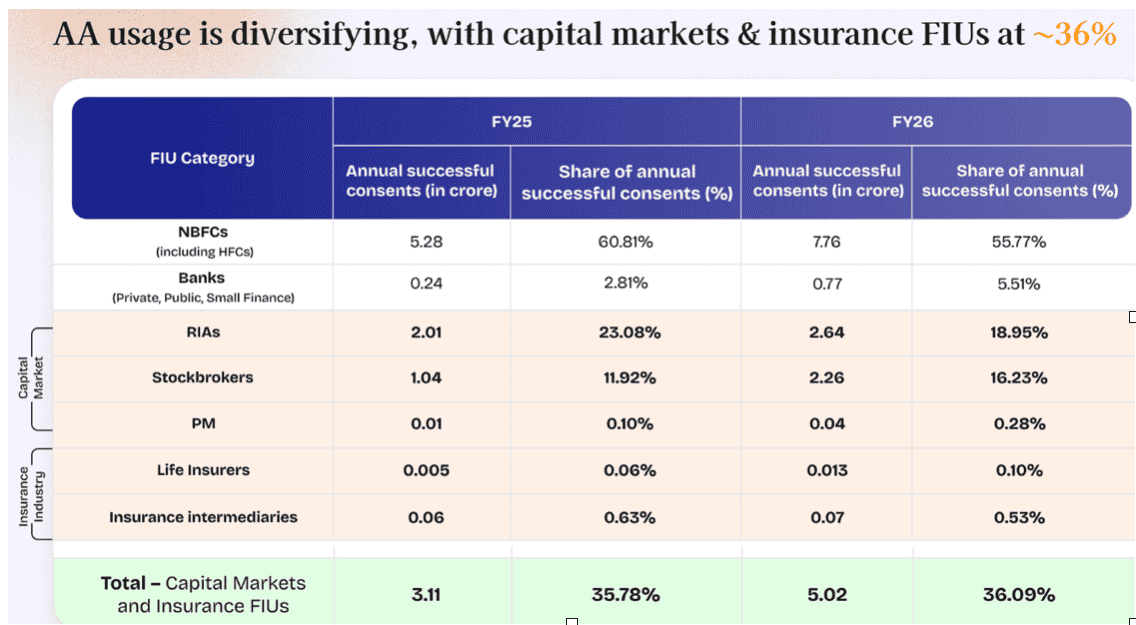
Source: Sahamati
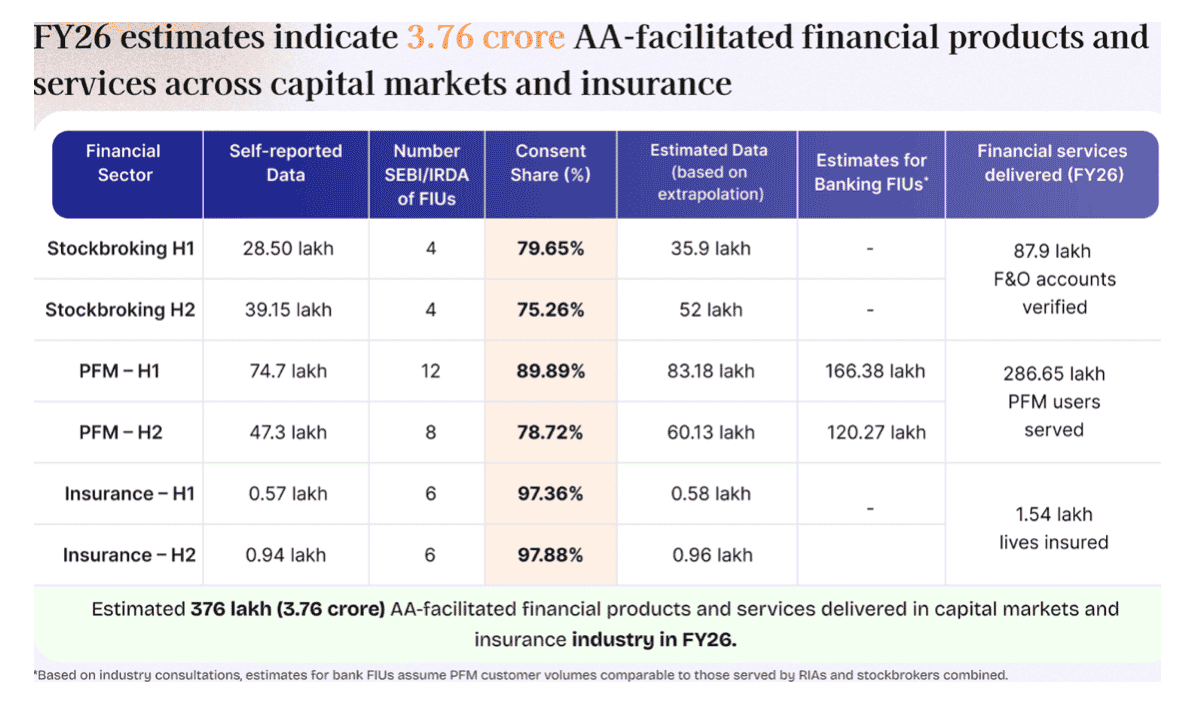
Source: Sahamati
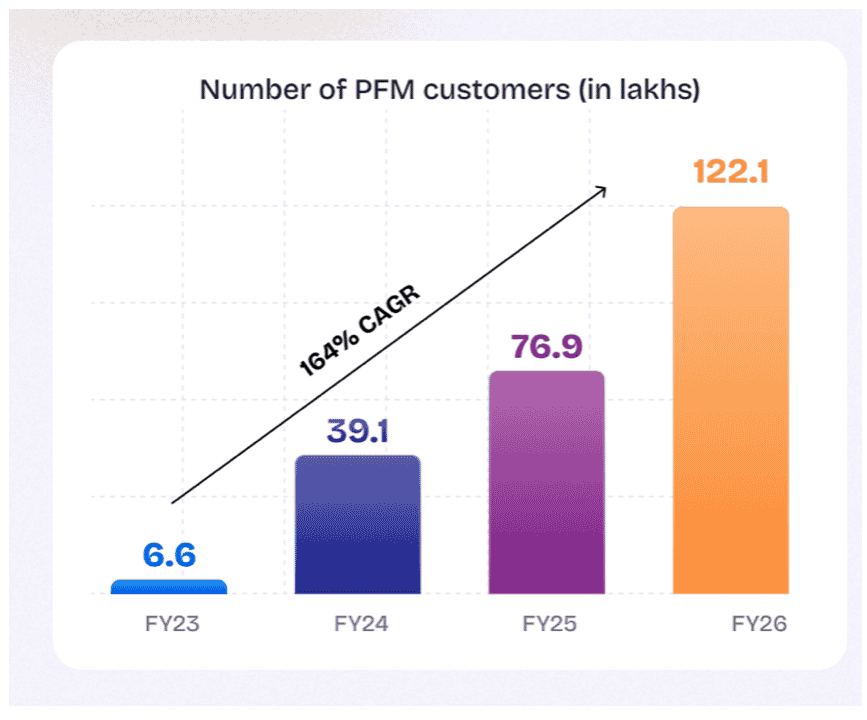
Source: Sahamati
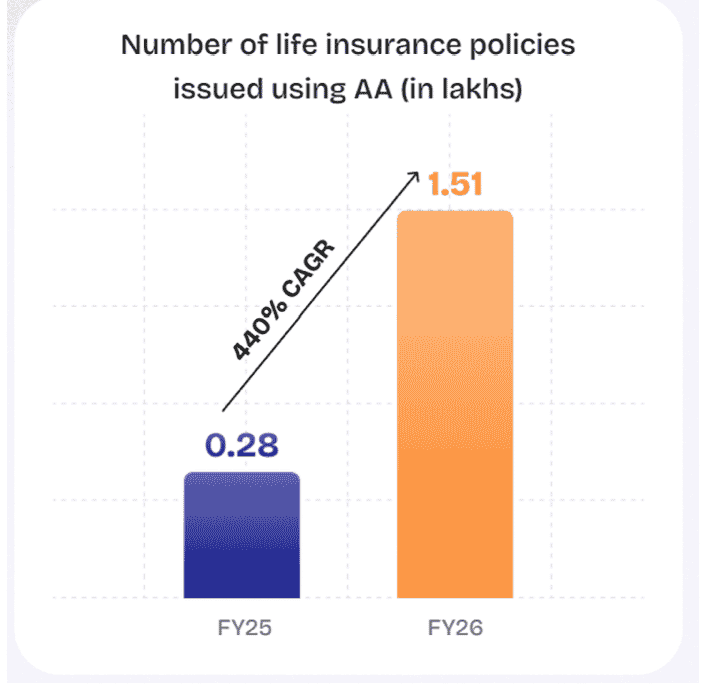
Source: Sahamati
AA – core digital infrastructure
Lending
Most LOS and LMS applications have embedded AA for seamless, reliable and straight-through credit processing, portfolio monitoring and collections. Entities that have reaped benefits from AA are becoming case-studies for other big and small lenders to learn and follow suit. Success of AA is validated by better friction-less loan journeys, quicker disbursals, early warning signals of any impending stress, % improvements in collections via timely eNACH debits. In summary, AA is an integral part of a lender’s core modules.
Other services
AA is the default data-seeking rail for large stock brokerages and wealth managers to better serve their customers. For example, in the case of F & O onboarding, brokers prefer AA-sourced bank statements as they are authentic, swift and can be seamlessly integrated.
AA drives financial sector transformation
Account aggregation helps transform the financial sector by bringing a customer’s financial information from multiple institutions into one secure, consent-based view. This creates value for customers, financial institutions and the broader financial ecosystem.
Key ways it drives transformation
- Better customer experience
Customers can see bank accounts, investments, insurance, pensions, etc. in one place.
Reduces the need to repeatedly submit statements and documents.
Enables more personalized financial-management tools.
- Data-driven lending
With customer consent, lenders can access real-time financial information rather than relying solely on traditional documents.
This can improve credit assessment, particularly for customers with limited formal credit histories.
Faster data access can reduce loan-processing time and operational costs.
- Personalized financial products
Aggregated data gives institutions a more complete picture of a customer’s financial situation.
Banks can offer more relevant savings, investment, insurance, or credit products.
It shifts financial services from product-centric to customer-centric models.
- Open banking and fintech innovation
Account aggregation is a key building block of open banking.
It allows authorized third-party applications to build services on top of financial data, with customer consent.
This encourages new business models beyond traditional banking.
- Operational efficiency
Automated retrieval of financial data can replace manual collection and verification of statements.
Institutions can reduce paperwork, reconciliation, and data-entry costs.
Faster, standardized data flows also make digital onboarding easier.
- Financial inclusion
Alternative financial data can help institutions assess customers who may not have extensive traditional credit histories.
This can potentially expand access to formal credit and other financial services.
- Improved financial decision-making through “Self Consent”
Customers can obtain a consolidated view of cash flows, liabilities, investments, and spending.
This supports budgeting, wealth management, tax planning, and debt management.
In summary, Account Aggregation will evolve from the current B2B2C model to a B2C model equally as a B2B model. The key objective with which AA was launched in India, was to give the power of controlling her data to the customer. By eliminating fragmented data, the FIs, on one hand, stand to benefit with robust models and on the other, Customers can better organize their financial lifecycle when the complete picture is presented via AA apps.

The article has been written by Venkatesh Krishnamoorti, Co-Founder and CEO of Saafe (a leading account aggregator)