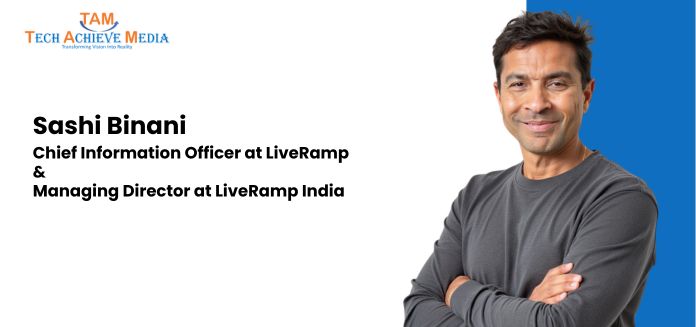
As AI reshapes how enterprises operate, the role of the CIO is evolving from technology steward to business enabler, connector and transformation leader. Sashi Binani, Chief Information Officer at LiveRamp and Managing Director, LiveRamp India, brings a perspective shaped by experience across product, engineering and IT, with a strong focus on customer centricity, people and business outcomes. In this conversation with Tech Achieve Media, Binani discusses the lessons from driving large-scale technology transformation, the changing role of IT in the AI era, the need to reimagine work, and his vision for building LiveRamp India as a hub for innovation and future technology leadership.
TAM: From your professional milestones to taking the helm as Managing Director and CIO at LiveRamp India, what core philosophy has anchored your career evolution through the enterprise technology landscape?
Sashi Binani: My career has been anchored by a simple intersection: the power of technology married to deep customer centricity. I started as a builder in product and engineering, and later transitioned into IT. That experience has stayed with me. I enjoy understanding how the pieces fit together: the customer needs, the business strategy, the process, the data, the technology, and most importantly, the people who have to make it work. Technology is valuable when it helps the organization move with more clarity, confidence, and speed.
I also believe that leadership is a multiplier role. The impact you can have through a team is exponentially greater than what you can do alone. My job is to create clarity, put the right people in the right positions, remove obstacles, and help teams turn good ideas into outcomes. That is the mindset I bring to both my global CIO role and LiveRamp India: build thoughtfully, stay close to the business, operate with a growth mindset, treat people with candor and respect, and always connect technology back to meaningful impact.
TAM: Leading technology transformation requires navigating both legacy friction and modern agility. What is the most critical lesson you’ve learned about driving large-scale tech shifts successfully?
Sashi Binani: The most important lesson is that transformation is not primarily a technology exercise. It is a people, process, and business transformation. Technology enables the transition. Legacy friction is rarely just a result of an old system. It is usually a combination of smaller friction points in data, processes, incentives, habits, and decision rights that have accumulated over time. So the lesson has been to ensure all these tracks are working together in harmony, and compliment each other
Clarity in decision making is another lesson. Very often, we struggle with the lack of decision making. My style is to connect the dots, align on outcomes and then create room for honest debate, listening to the other side before making a decision. Once a decision is made, we move with urgency. I believe in progress over perfection, provided we are learning deliberately and measuring whether the change is producing the intended outcome.
That is particularly important with AI. Waiting for the technology, the data, or the organization to be perfect can become an excuse for inaction. A better approach is to focus on a small number of high-value use cases, co-create with the teams doing the work, establish feedback loops, and scale what works. AI transformation succeeds when people are enabled and empowered—not simply when a tool is deployed.
TAM: As a CIO today, the intersection of business strategy and technology execution is tighter than ever. How has your approach to enterprise technology leadership adapted to meet modern business demands?
Sashi Binani: This is an exciting time to be a CIO. AI is driving a fundamental shift in how we work, and CIOs are in the driver’s seat to drive that transformation. The rate of change is significantly higher than ever and that requires adapting. The traditional role of IT is getting disrupted and it requires us to adapt, stay nimble and be willing to adopt new ways of working. Here are few things I think about these days:
IT’s role is evolving: We’re seeing more knowledge workers across the enterprise developing technical solutions using vibe coding and AI tools. IT needs to understand how to support them, and then take these innovative ideas and solutions, and be the last mile delivery partner to make them production-ready.
In addition, AI has made it clear that a powerful model is not enough. If the data is fragmented, inaccessible, or poorly governed, the organization cannot reliably turn intelligence into action. At LiveRamp, where trusted data collaboration is central to our business, that discipline is especially important.
Reimagine Work: If we keep working the same way and apply AI on top of it, we will get marginal improvements at best. We need to reimagine work to unlock the full transformative potential of the technology. As connectors, CIOs have a unique opportunity to show what great looks like and drive this transformation within organizations.
Focus on Business Outcomes: What stays true is that it’s rarely about which tool should we buy, but rather about what problem are we solving, what capability do we need, and what value will it create. I care much more about the outcome than the activity.
A CIO as a technical expert is given, but a CIO as a connector and an enabler is where it’s fun . I try to connect business leaders, technology teams, data owners, security, legal, and our global and local organizations. The goal is to make good decisions faster while preserving the controls and trust that allow us to scale.
TAM: What do you consider your most defining contribution to LiveRamp India thus far, and how are you scaling that vision for the future?
Sashi Binani: I believe that the best from LiveRamp India is ahead of us. Our vision for India is not only for excellent execution, but also as a center of innovation, solving hard problems, developing future leaders, and creating ideas that travel across the company.
The launch of the Hyderabad office and hiring around 250 LiveRampers is just the beginning for us. What excites me most is the depth of talent in India and the opportunity to harness it for real innovation globally. It feels a little like a startup: we are not inheriting a complete playbook; we are writing it. That creates an unusual opportunity to establish the right norms from the beginning: candor, accountability, collaboration, urgency, and a strong bias toward action.
TAM: Looking at the broader technology horizon, what is your guiding principle for empowering high-performing tech teams and cultivating future leaders?
Sashi Binani: My guiding principle is to create clarity, trust, and room to grow, and to pair empowerment with accountability. People do their best work when they understand the outcome that matters, know how decisions will be made, and have the freedom to solve the problem in their own way. My role is to provide context, set a high bar, remove obstacles, and make sure the team has the capabilities and support to succeed. It is not to be the smartest person in every room or to become the approval point for every decision. We are operating in a world where technology shifts faster than ever. My job is to ensure my leaders are adaptable, valuing a ‘learn-it-all’ mindset above all else, and that we build development into the work itself, not as an afterthought