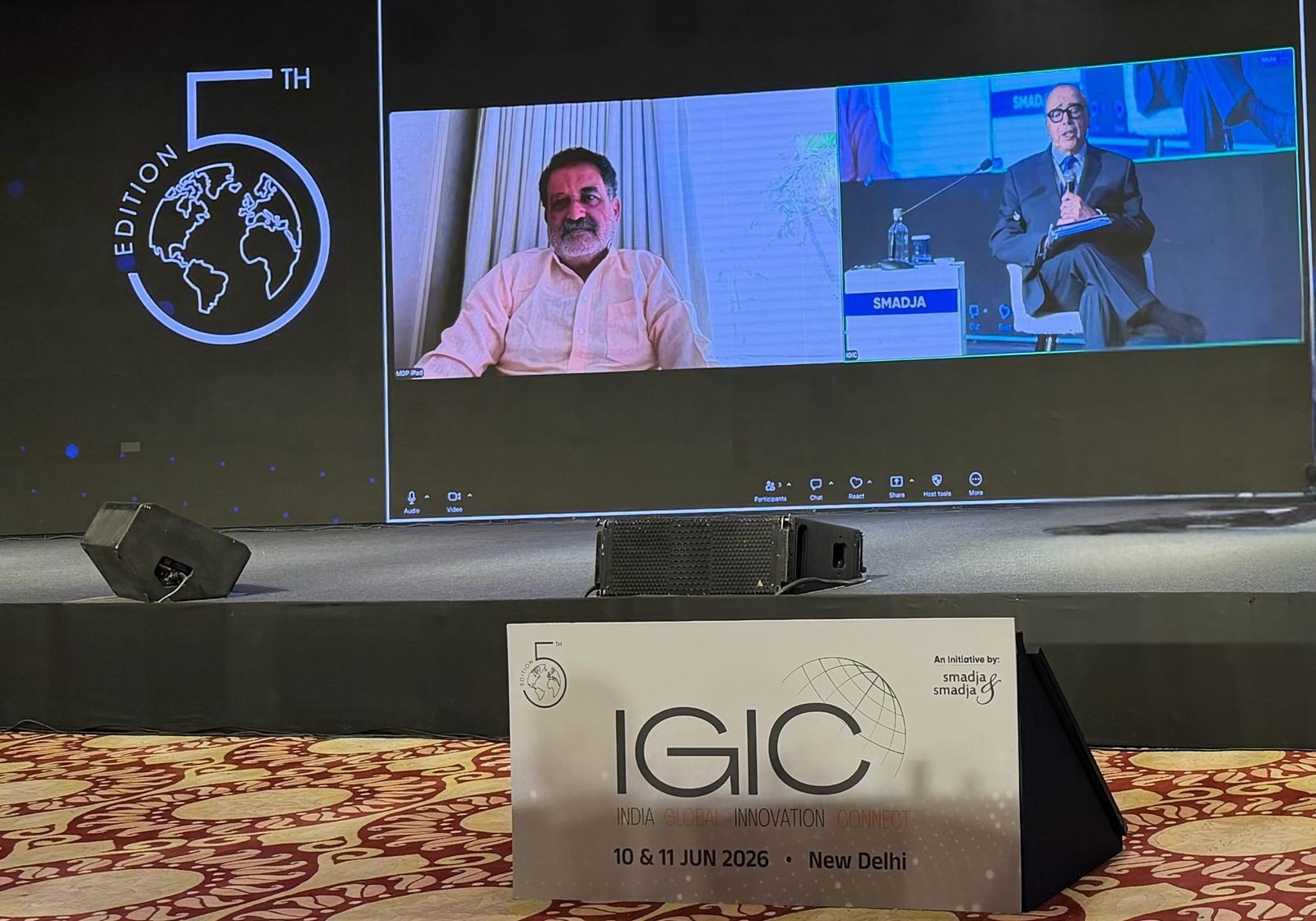
India’s journey towards becoming an AI powerhouse will depend on its ability to build capabilities across the entire artificial intelligence stack, from power and chips to hyperscale data centres, large language models (LLMs) and AI applications, rather than simply adopting AI tools, according to Mohandas Pai, Chairman, Aarin Capital. Speaking with Claude Smadja, Chairman, Smadja & Smadja Strategic Advisory, at IGIC 2026, Pai said AI represents the biggest technological disruption the world has witnessed and warned that India cannot afford to move slowly: ”Being AI-ready means understanding the five layers of AI and having investments across all those five layers. Only then will we be able to use AI to grow business, grow society and compete globally.”
Also read: IGIC 2026 to be Held on June 10-11 in New Delhi
He described AI as a transformation unlike previous technology revolutions: ”We saw the disruption of the internet over nearly 20 years. AI has emerged in just the last three years and could completely change the world within the next five years. People estimate that 60-70 per cent of human activity can potentially be done by AI.” Pai noted that global investments running into trillions of dollars underline the seriousness with which countries are approaching AI.
How should India respond to the global AI boom?
According to Pai, India has significant strengths but also substantial gaps that need urgent attention. He identified five foundational layers of AI: power infrastructure, semiconductor chips, hyperscale data centres, LLMs and AI applications. Explaining the importance of energy infrastructure, he said: “AI consumes enormous amounts of power. Countries need to ramp up power generation for hyperscale data centres. India has around 540 gigawatts of power capacity, possibly the third largest in the world, with nearly 50 per cent being green power. That gives us a strong foundation.”
However, he pointed out that semiconductor manufacturing remains India’s weakest link: ”The state-of-the-art AI chip is the GPU, and NVIDIA is driving that ecosystem. India does not yet have a chip industry at the scale required for AI.” On data centre infrastructure, Pai said India is making encouraging progress: ”India today has created around two gigawatts of AI capacity, and by 2030 we could have ten gigawatts. Nearly $100 billion of investment is coming from companies such as Google, Microsoft, AWS, Reliance and Adani.”
Pai believes India must move beyond being an AI consumer and become an AI creator. While acknowledging that India lacks a large foundational LLM ecosystem, he sees opportunities in specialised models: ”India’s opportunity is to create vertical LLMs that can be used for financial services, healthcare and many other sectors. Our IT services companies are working on that, and India could become a serious competitor.” He also highlighted the vibrant startup ecosystem: ”There are hundreds and thousands of AI companies coming up. We have invested in eight or nine AI startups in just the last year.” But he warned that startups alone cannot build India’s AI future: ”Many companies have to come up and spend a couple of billion dollars in the next few years to create India’s own AI infrastructure.”
Is the gap in global investment a major concern?
Pai answered with an unequivocal yes: ”We have a major concern because we lack the R&D ecosystem for the chip industry and we do not have the amount of investment being committed by our companies. We are behind the curve.” He argued that India’s capital commitment remains insufficient compared to global competitors: ”The large Indian corporates have to invest. The large Indian IT services companies have to step up. Unless many companies invest billions of dollars, we will continue to lag.” Pai also criticised India’s low research spending: ”The total R&D spending in India is only 0.75 per cent of GDP, whereas we need 3 to 4 per cent. Even increasing it to 1 per cent would be a significant improvement.”
Should India prioritise ‘Make in India’ or global technology partnerships?
While recognising India’s limitations in hardware manufacturing, Pai advocated a balanced strategy that combines domestic capability building with international collaboration: ”We have the software side but not the hardware. Hardware takes time. We have professionals in the chip industry, but scaling up has to happen much faster.” He stressed that India cannot afford to wait: ”The speed of change is extraordinary. Every few months new AI applications are emerging. We have to move much faster.”
Pai believes India’s diversity is becoming a competitive advantage rather than a barrier. He pointed to rapid advances in multilingual AI solutions: ”That problem has been largely solved. There are many startups offering simultaneous translation across Indian languages.” He cited ongoing initiatives that use AI to democratise education: ”AI is helping translate engineering textbooks and educational content into Indian languages. People should be able to learn in their own language while also learning English.” Pai believes this transformation will have far-reaching consequences: ”Within two or three years, any rural person should be able to transact with banks or businesses in their own language, with AI automatically translating into another language.”
For Pai, AI adoption must be measured by productivity gains rather than experimentation: ”We must improve productivity by 20 to 30 per cent across India. We must use AI for project management so projects are completed on time. We must use AI in manufacturing to improve productivity.” He also highlighted the importance of cybersecurity as AI capabilities become more powerful: ”We have to ensure that AI is also used to strengthen cybersecurity, especially for protecting our banking systems from attacks.”
What more should the government do?
Pai’s strongest message was directed at policymakers. He called for greater urgency and a coordinated national strategy: ”What worries me is the lack of speed on the government’s part. AI applications are evolving every few months, but government processes are still behind the clock.” Among his recommendations are a dedicated AI startup fund, greater public investment in cloud infrastructure and stronger support for Indian LLM development: ”The government should create a large fund immediately where it can partner with venture capital firms to support AI application startups.” He also urged collaboration with India’s leading technology companies: ”The government must work with three or four big IT companies to create their own LLMs and support vertical LLM development.”
Pai concluded that India’s biggest challenge is not talent or market size but execution speed: ”The world is not understanding the speed of change. We are the third largest digital power in the world. The speed has to be much faster.” Calling for decisive leadership, he said India needs a coordinated national approach to remain globally competitive: ”Urgency and speed are what matter. We need a national clear understanding, with the Prime Minister at the head.” For Pai, India’s AI opportunity remains enormous, but capital investment, research spending, corporate participation and policy execution will determine whether the country emerges as a global AI leader or remains dependent on technologies built elsewhere.