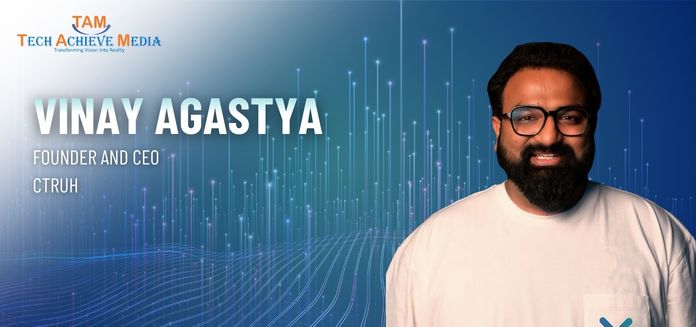
As immersive technologies move from experimentation to mainstream adoption, the conversation around extended reality (XR) is shifting from futuristic possibilities to practical business applications. Advances in browser-native 3D, artificial intelligence, cloud infrastructure and spatial computing are making immersive experiences more accessible, scalable and cost-effective than ever before. In this interaction with The AI Media (TAM), Vinay Agastya, Founder and CEO of Ctruh, discusses why app-free XR is gaining momentum, how AI is democratizing 3D content creation, the role of affordability in driving adoption in India, and why the spatial web could quietly become the next major evolution of the internet.
TAM: Why do you believe browser-native 3D and XR could become the next major shift for businesses globally?
Vinay Agastya: Every major computing shift has followed the same arc: technology starts bulky and expensive, then becomes personal and invisible. Computers became desktops, desktops became smartphones, and now digital experiences are moving closer to human interaction itself.
Browser-native 3D is that next step. It removes the dependency on apps, installs, and specialized hardware, making immersive experiences instantly accessible across any device. When a technology becomes frictionless, adoption stops being a choice and starts becoming inevitable.
For businesses, this means the language of the internet is shifting from viewing to experiencing, and that changes every customer touchpoint. That is the shift we are building toward at Ctruh.
TAM: What has changed that now makes “app-free XR” possible?
Vinay Agastya: For years, the biggest barrier to XR was dependency. The moment a user had to download an app or buy hardware, drop-offs began. What has changed is that the underlying infrastructure has finally matured. Browser-native 3D engines, faster internet, cloud compute, and AI-driven creation pipelines have collectively removed those barriers.
The experience simply works, the same way a website works. That shift from gated to frictionless is what makes app-free XR not just possible but commercially practical today. And honestly, it is why we spent three years building a browser-native engine from the ground up rather than layering on top of existing tools that were never designed for this.
TAM: What is finally driving real enterprise adoption of XR now?
Vinay Agastya: The honest answer is economics. XR experimented well for years but rarely delivered ROI because production costs were high, deployment was fragmented, and scalability was limited. That equation has changed. AI-powered creation tools and browser-native infrastructure have dramatically reduced the cost and complexity of deploying immersive experiences. Simultaneously, consumer expectations have risen. Customers want to interact with products, not just view them. Enterprises now see immersive experiences not as a marketing experiment but as measurable business infrastructure that improves conversion, engagement, and retention. The businesses we work with are not asking whether to adopt XR anymore. They are asking how fast they can deploy it.
TAM: How important is affordability in making immersive digital experiences mainstream, especially for India?
Vinay Agastya: Affordability is everything. No matter how powerful a technology is, if it is financially out of reach for most businesses, it stays niche. India is a market where the majority of commerce happens outside Fortune 500 boardrooms. Startups, mid-market brands, regional retailers, and D2C businesses need solutions they can actually afford. Democratization of access is not just a positioning statement. It is the only way the category scales in markets like India. And it is something I think about constantly, because building something technically impressive that only five percent of businesses can afford is, in my view, a failure of product thinking.
TAM: Does AI-generated 3D from text, images, and video dramatically reduce the skill barrier?
Vinay Agastya: Yes, and the impact is significant. Traditional 3D production was deeply fragmented. A single asset could involve modelers, animators, rendering specialists, and optimization teams, often taking weeks. With VersaAI, we convert images, text, and video into production-ready 3D in minutes. But the transformation is not just about speed. It is about democratization.
3D creation is shifting from skill-restricted to idea-driven. Small brands and independent creators can now build experiences that previously only large enterprises could afford. I always say that AI is not replacing creativity. It is removing the friction between imagination and execution, and that is the most important thing any tool can do.
TAM: How do you see India’s deep-tech ecosystem evolving in spatial computing and immersive internet?
Vinay Agastya: India is still in early adoption, but the foundation is being built fast. Deep-tech funding grew significantly in 2025, and the Government of India has formally expanded its deep-tech startup framework in early 2026. Policy support through the AVGC-XR initiative signals that spatial computing is being treated as strategic infrastructure, not consumer entertainment.
India has the engineering depth, the cost advantage, and increasingly the ambition to build foundational spatial internet infrastructure for global markets. What Bengaluru was to software services, it could become to spatial computing. We are certainly trying to make that case from where we sit.
TAM: What differences are you seeing in how US and UAE enterprises approach XR adoption?
Vinay Agastya: The US is driven by enterprise performance metrics. Brands there want to know the ROI before they commit, but when the data is compelling, adoption moves fast.
Apple Vision Pro enterprise rollouts and spatial computing integrations are accelerating the conversation significantly. The UAE and broader MENA region is different. Government vision is doing much of the pulling. Saudi Vision 2030, the NEOM build-out, and heritage digitization initiatives mean that XR adoption there is tied directly to national ambition.
Both markets are beyond asking whether to adopt XR. The conversation has shifted entirely to how and how quickly. That is exactly why we are entering both in 2026.
TAM: What will surprise people most about how immersive experiences enter everyday business and consumer life?
Vinay Agastya: The biggest surprise will be how unremarkable it becomes. People expect the transition to feel dramatic, like putting on a headset or entering a virtual world. The reality is subtler and more pervasive. Immersive experiences will embed themselves into ordinary touchpoints: product pages, property listings, automotive configurators, fitness coaching, retail discovery.
Most users will not think of it as XR at all. They will simply notice that digital interactions feel more real, more useful, and more confident than before. The spatial web will not announce itself. It will quietly become the way things work. And the companies building the infrastructure for that shift today are the ones that will define what the internet looks like tomorrow.