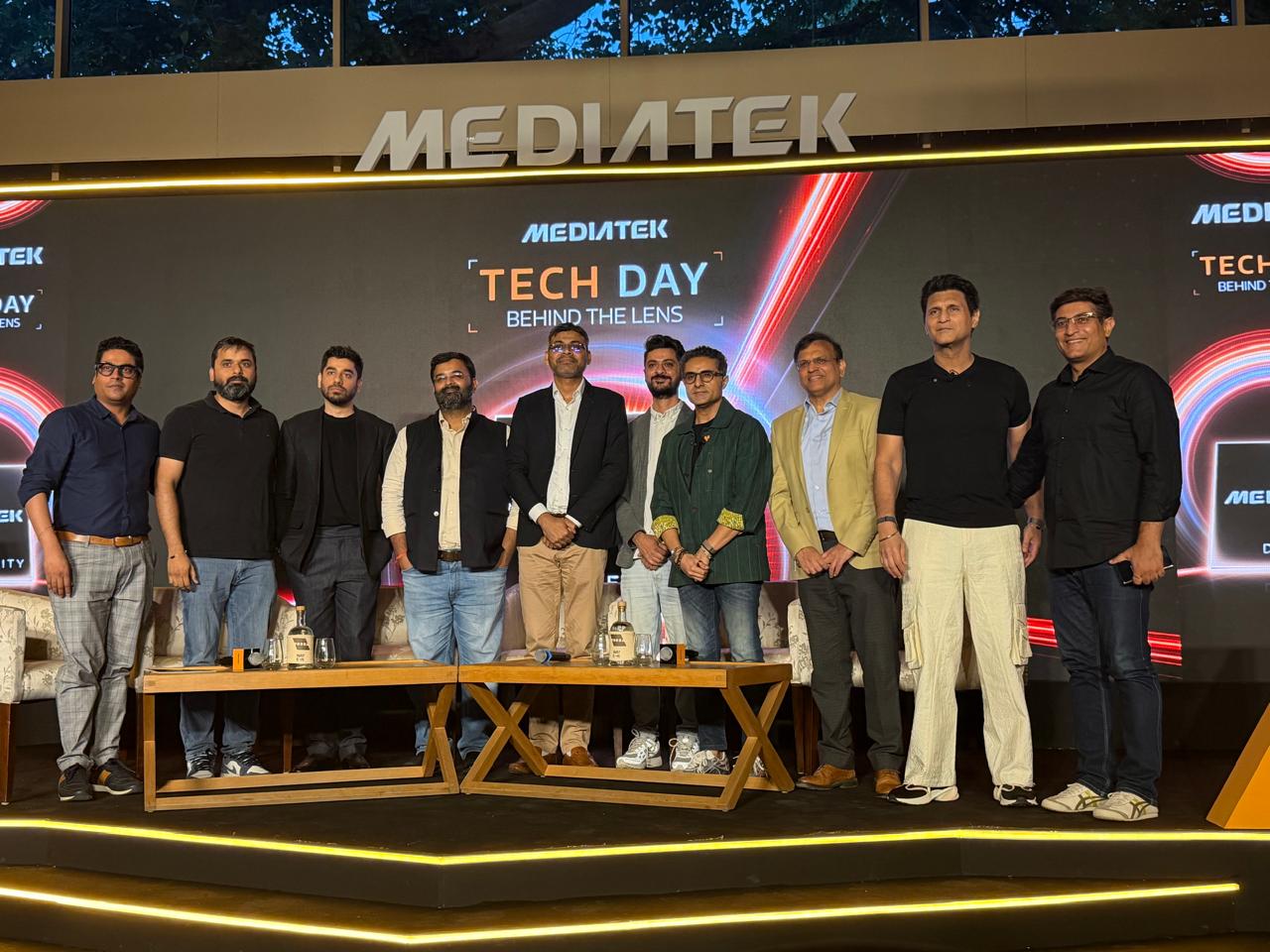
Smartphone photography is no longer defined by camera sensors or megapixel counts alone. It is the result of multiple technologies working together behind the scenes including the chipset, image signal processor (ISP), artificial intelligence (AI), software and optics. This was the central theme of MediaTek Tech Day: Behind the Lens, held in New Delhi, where the company highlighted how system-level engineering is shaping the next generation of mobile imaging. The event brought together technology experts, smartphone brands and industry leaders to discuss how advances in chip design, AI and computational photography are changing the way images and videos are captured on smartphones.
Also read: MediaTek to Empower the Agentic AI Era with Edge-to-Cloud Tech at Computex 2026
Speaking at the event, Anuj Sidharth, Director – Marketing and Corporate Communications, MediaTek India & SEA, said smartphone cameras should no longer be viewed as standalone hardware components but as integrated imaging systems. “A camera isn’t just a feature on a smartphone. It is a complete system, where every component, from the SoC and ISP to the sensor, works together to deliver that single moment of trust,” he said.
From Megapixels to Intelligent Imaging
Tracing the evolution of smartphone cameras, Sidharth said imaging technology has undergone a significant transformation over the past two decades: ”Camera technology is not new for MediaTek. For over two decades, our chipsets have been powering camera technologies. What started as a simple tool to capture memories has evolved into a sophisticated system where light, silicon and intelligence work together in real time.”
He noted that smartphones have progressed from 1.3-megapixel sensors to cameras exceeding 200 megapixels, reflecting not only improvements in image quality but also a shift in how hardware and software collaborate. According to Sidharth, recent generations of smartphones powered by MediaTek Dimensity processors have introduced capabilities such as advanced HDR imaging, 4K 120fps video recording and computational photography that were previously difficult to achieve on mobile devices. However, he emphasised that capturing high-quality video is only part of the challenge: ”Capturing incredible video data is one thing, but processing it, playing it back and streaming it efficiently without draining the battery is a completely different challenge.”
Efficiency and AI Drive Modern Smartphone Cameras
Sidharth said MediaTek’s focus has been on improving power efficiency while enabling advanced imaging experiences. “We build our chips with efficiency at the core so users can continue using their cameras without worrying about excessive battery drain or overheating,” he added. He highlighted that AI has become an integral part of modern smartphone photography: ”A chipset like the Dimensity 9500 comes with one of the world’s most advanced AI-enabled ISPs. Computational photography has evolved to a level where the chipset is making millions of intelligent decisions every second.” According to him, the true innovation lies not in individual hardware components but in how they function together: ”Raw power alone is not enough. The real magic lies in how everything works together. The SoC, imaging processor, sensors and even the touch panel are optimised independently, yet synchronised to work as a unified system. That’s where the real strength of our chipsets comes from.”
Highlighting practical applications, Sidharth said the company’s imaging technologies have been designed to improve everyday photography scenarios, including fast-moving subjects and video capture: ”Fast-moving objects have always been challenging to capture. Our end-to-end system design enables ultra-fast autofocus and intelligent image processing to strike the right balance between resolution and sharpness.” He also acknowledged the role played by smartphone manufacturers: ”Our OEM partners are an essential part of this ecosystem. Their smartphones enable consumers to experience these imaging capabilities in real-world scenarios.”
AI Expanding Beyond Smartphones
Addressing the gathering, Anku Jain, Managing Director, MediaTek India, said AI is rapidly becoming a foundational technology across industries and devices: ”AI is now present across almost every category of devices. Smartphones are only one example. We are seeing AI PCs, AI-powered data centres and several other emerging applications. This represents a significant opportunity, and we intend to be part of that growth.” Jain said MediaTek expects AI-led businesses to contribute significantly to its future growth: ”We expect significant revenue from our AI business by the end of this year, with further growth expected next year. It is an exciting area not just for us, but for the broader semiconductor ecosystem.”
Speaking about India’s semiconductor landscape, Jain welcomed recent government initiatives aimed at strengthening domestic manufacturing and innovation: ”The semiconductor industry in India is developing rapidly. Initiatives such as Semicon 2.0 demonstrate the country’s long-term commitment to building a strong semiconductor ecosystem.” He reiterated that India remains a strategic market for MediaTek: ”India continues to be an extremely important market because of its young population and rapidly evolving technology ecosystem. We also continue to invest in research and development through our engineering centres in Bengaluru and Coimbatore.”
Industry Experts Discuss the Future of Smartphone Photography
One of the highlights of the event was a panel discussion moderated by technology journalist Rajiv Makhani, featuring Rahul Jhangiani, expert photographer; Shivam Ranjan, Marketing Director APAC, Motorola; Paigham Danish, CTO, Head of Product & GTM, vivo India; Gautam Batra, Associate Director, Product Marketing, Xiaomi India; and Anuj Sidharth.
The discussion explored how smartphone photography has evolved beyond camera hardware to become an integrated imaging ecosystem. Panelists discussed the growing role of AI, image sensors, optics, software and chipsets in delivering better imaging performance, while emphasising that the processor has become one of the most critical components in determining the final image quality. The session also examined how smartphone brands collaborate with chipset manufacturers to optimise imaging capabilities and deliver differentiated photography experiences.
Concluding the event, Sidharth reiterated that smartphone cameras should be viewed as intelligent systems rather than standalone features. “For most consumers, a great camera is one that simply works without them having to think about it. Behind that simplicity are years of work across silicon, architecture and system design. We don’t think about the camera as a feature; we think of it as a complete system where every component, from the SoC and ISP to the sensor, works together to earn that single moment of trust,” he said.