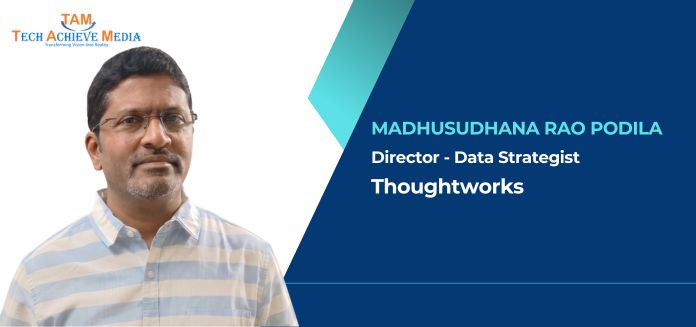
Companies have spent years collecting vast amounts of data, yet many leadership teams still struggle to translate those investments into measurable business outcomes. In an exclusive conversation with Tech Achieve Media, Madhusudhana Rao Podila, Director – Data Strategist at Thoughtworks, shares his perspective on why business-first thinking, strong data governance and smarter AI adoption are essential for turning data into competitive advantage.
TAM: Many Indian enterprises have gathered massive amounts of data over the last few years, but leadership teams still struggle to see a clear Return on Investment (ROI). As a Data Strategist, how do you help companies convert raw data into actual business revenue?
Madhusudhana Rao Podila: The challenge is familiar – most data programs I’ve seen were born in the IT department and never really escaped. Teams spend months, sometimes years, building platforms and pipelines, and by the time they’re ready to show something, the business has already moved on. The disconnect usually isn’t technical; it’s structural.
What actually works is starting with the business case, not the platform. Before any infrastructure decisions are made, the first question should be: what decision does this data need to support, and who is responsible for making it? That conversation surfaces the right priorities early, and once you have alignment, you can build a roadmap where every data initiative ties directly to a business outcome. The ROI question suddenly becomes a lot easier to answer. The other factor that consistently gets missed is ownership. Without a business sponsor who has accountability for outcomes, and domain owners who are responsible for data quality, these initiatives drift. IT can build a beautifully engineered data lake but if nobody in the business actually claims the data, it quietly becomes a swamp.
TAM: Everyone wants to jump straight into advanced AI tools, but their internal data is often messy or scattered across different departments. How critical is a clean ‘data foundation’ before an organization can even think about an AI-first strategy?
Madhusudhana Rao Podila: The honest answer is: you can get started with imperfect data, but you can’t sustain AI with it. I always frame this as a trust question, not a quality question. Data quality tends to get treated as a technical checkbox, fix some nulls, run some validation rules, declare it done. But AI needs data it can rely on consistently, across contexts, at any point in time. That’s a meaningfully higher bar.
There’s also a dimension most data teams haven’t historically designed for: AI agents as consumers. When a human looks at data and something seems off, they notice and compensate. When an agent does, it doesn’t – it produces a wrong answer with full confidence. That’s why the semantic and knowledge layer matters so much now. It’s not just about storing data cleanly; it’s about surfacing context and meaning in a way that non-human consumers can reason against accurately. Companies that skip this step and jump straight into AI pilots typically find they’re spending 80% of their time debugging data issues, not model behavior. Getting the foundation right isn’t the slow path; in practice, it’s actually faster.
TAM: From your experience on the ground, how many Indian companies are moving past just experimenting with chatbots to implementing deep, structural data engineering changes
Madhusudhana Rao Podila: The chatbot wave served a real purpose, low risk, visible, easy to show to leadership. But the ceiling on chatbots is fairly low, and a lot of organizations are already bumping into it. What I’m seeing now is a genuine shift toward AI embedded in actual operational processes. Not just helping someone draft a response or summarize a document, but operating within workflows – automated underwriting, dynamic pricing, AI-assisted field operations. The ambition has moved up a level.
And that’s exactly where the structural data engineering challenge becomes unavoidable. Chatbots could absorb a certain level of data imprecision because a human was in the loop reviewing responses. The moment you embed AI in an operational process, that buffer disappears — every data gap that was merely annoying before becomes a hard blocker. The organizations making this transition successfully are the ones building that underlying data infrastructure in parallel with the AI work, not as a post-thought.
TAM: Building and running complex AI models requires high computing power and heavy investment. What is your advice to CXOs on managing the high infrastructure costs of data engineering while scaling their AI projects?
Madhusudhana Rao Podila: My standing advice to CXOs is: don’t lead with infrastructure investment. Lead with use cases, and let the infrastructure requirements follow from there. In practice, that usually means starting with API-based access to foundation models. You move fast, validate what actually delivers value, and defer the heavy infrastructure decisions until you have proof. Once specific use cases show clear ROI, then you can make targeted choices about model hosting, and at that point, smaller, domain-specific models become very attractive. They’re cheaper to run, faster to fine-tune, and often outperform large general models on narrow tasks.
Composability matters a lot here too. Build with modular, interchangeable model chains rather than committing to a single vendor end-to-end. The market is moving fast enough that what’s optimal today may not be in six months, you want to swap components without rewiring everything. The piece most organizations underinvest in is FinOps and observability and these need to be designed in from day one, not bolted on later. Inference costs scale faster than most teams expect once you move beyond pilots. Real-time visibility into what’s being consumed, by what, and whether it’s delivering value: that’s what lets CXOs make intelligent trade-offs rather than just watching the bills go up.
(Disclaimer: The opinions shared in this interview are solely those of Madhusudhana Rao Podila and are presented as part of an editorial conversation conducted by Tech Achieve Media.)