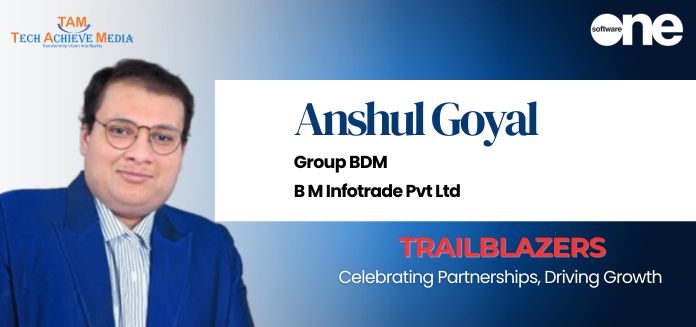
As Indian enterprises accelerate their digital transformation journeys, cloud computing is evolving from a cost-optimization tool into a strategic business enabler that powers innovation, agility, and data-driven decision-making. With growing adoption across manufacturing, BFSI, healthcare and emerging Tier 2 and Tier 3 markets, organizations are increasingly seeking partners that can deliver measurable outcomes rather than just technology implementation. In an exclusive interaction with Tech Achieve Media, Anshul Goyal, Group BDM, B M Infotrade Pvt Ltd, shares his perspective on India’s evolving cloud landscape, the role of AI and IoT in creating business value, the importance of trusted partnerships, and how the company is positioning itself to help enterprises build resilient, future-ready digital ecosystems.
Also read: Soc Services – Connecting Jaipur and Gurugram through Service
TAM: How do you see the cloud computing market in India evolving over the next five years, and what role do you envision your company playing in shaping this growth?
Anshul Goyal: India’s cloud market is at a genuine inflection point. The conversation has shifted from “how do we cut costs by moving off on-premise servers” to “how do we use cloud to grow revenue and make faster decisions.” That’s a fundamental change in mindset, and it’s happening across sectors from manufacturers in Rajasthan to NBFCs in Pune.
Over the next five years, we expect significant cloud uptake in Tier 2 and Tier 3 cities, in sectors like healthcare, BFSI and agritech, and a sharper focus on data sovereignty as Indian regulations evolve.
BM Infotrade has been part of this market since 1996, through every wave of technology change. That institutional memory is a real advantage. We are not parachuting into this opportunity; we have three decades of trusted relationships with businesses across India. Our role is to help mid-market and enterprise India move from simply being “on the cloud” to actually deriving measurable business value from it.
TAM: In a highly competitive Indian cloud ecosystem, what truly differentiates your offerings and approach from other service providers?
Anshul Goyal: At the product level, differentiation is harder than ever, AWS, Azure, and Google Cloud are available to every partner in the country. The real question is what you do around those platforms.
For us, it comes down to three things. First, we solve problems before we sell solutions. When clients come to us, our team sits down and understands actual requirements before making any recommendation and we are known for recommending what’s right, not what’s most expensive. Second, we believe in knowledge transfer, not dependency. We invest in making our clients smarter about their own IT environments, because a confident client is a long-term client. Third, being headquartered in Jaipur gives us a grounded understanding of how businesses outside the metros operate their constraints and the trust they need before committing to a technology partner. That’s something metros-focused SIs genuinely struggle to replicate.
TAM: How is your organization leveraging emerging technologies such as AI, machine learning, and IoT to deliver measurable business value for customers?
Anshul Goyal: We are deliberate about this. AI is generating enormous excitement and enormous noise. Our job is to cut through that noise and ask one simple question for every client: what specific problem does this solve, and can you measure the outcome?
In practice, we are using AI-driven analytics to give manufacturing clients real-time visibility into production anomalies that previously took days to catch; building automated document workflows for NBFCs that significantly reduce manual data entry; and deploying chatbot tools that handle routine IT queries so human staff can focus on higher-order work. On IoT, we are connecting factory machines and sensors to cloud dashboards, giving plant managers information they previously waited weeks to compile.
The discipline we follow is: Proof of Concept before full deployment. We never ask a client to bet their business on a technology they haven’t seen working in their own environment first.
TAM: Indian enterprises have diverse and sector-specific requirements. How do you tailor your cloud solutions to address the unique needs of different industries and scales of operations?
Anshul Goyal: The failure mode for many IT companies is building a template and applying it everywhere. A BFSI client and a manufacturing client may both need “cloud,” but the similarities end there. For manufacturing, we focus on uptime and resilience including hybrid setups where factory floors keep running even if internet connectivity drops. For BFSI and NBFCs, the conversation is around RBI compliance, data residency, and 24×7 security monitoring. For SMBs, we focus on making enterprise-grade technology accessible right-sized solutions that don’t require a full IT team to manage. What ties this together is our Center of Excellence, where expertise across cloud, AI, cybersecurity, and digitization converges to design solutions for real operating environments not what looks good on a slide.
TAM: What are the key challenges you encounter in the Indian market today, and what strategies are you adopting to ensure long-term, sustainable growth?
Anshul Goyal: Three honest challenges. First, commoditization when any company can resell a cloud license, price pressure is intense. Our response has been to move toward managed services, cloud cost optimization, and advisory work, where the value we add can’t be replaced by the cheapest quote. We regularly help clients reduce AWS spend by 40–60% through FinOps practices that takes expertise, not just a reseller agreement.
Second, talent. Building teams that speak both technology and business fluently is genuinely hard. We invest heavily in internal training and knowledge-sharing culture. Third, trust especially in Tier 2 markets where businesses have been burned by vendors who over-promised and under-delivered. Our USP, “Commitment = Delivery,” is an internal discipline, not a marketing line. If we commit to something, we hold ourselves to it.
TAM: Could you share more about your partnership with SoftwareOne and how this collaboration strengthens your cloud and digital transformation capabilities for customers?
Anshul Goyal: For us, partnerships are not about logos on a page they are about what we can genuinely deliver that we couldn’t before. SoftwareOne is a global leader in software and cloud portfolio management. As Indian enterprises adopt multi-cloud environments, licensing becomes a real and often hidden business risk companies overpay, or fall out of compliance, without realizing it. This partnership allows us to bring structured Software Asset Management and financial governance to our clients, so they know exactly what they’re paying for and where they can optimize. Combined with our own capabilities in cloud migration, managed services, and security, it means we can support clients from technical architecture all the way to the commercial governance of their digital investments a much more complete picture.
TAM: Looking ahead, what is your long-term vision for India, particularly in serving high-impact sectors such as healthcare, financial services, and manufacturing?
Anshul Goyal: I want BM Infotrade to be the kind of IT partner that critical-sector businesses trust the way they trust a long-standing CA or legal counsel not just someone they call when something breaks, but someone with a seat at the table when important decisions are made. In healthcare, the gap in quality IT infrastructure and cybersecurity is significant, particularly in mid-sized hospitals and diagnostic chains and the stakes are the highest they can be. In financial services, regulatory demands will only intensify, and our ambition is to be the partner NBFCs, fintechs, and regional banks turn to when they need to be both competitive and compliant. In manufacturing, India’s industrial growth story, driven by PLI schemes and the China+1 opportunity demands smart factory infrastructure, and we want to help manufacturers become genuinely data-driven. The belief underlying all of it is one we have held since 1996: technology should make businesses more valuable, not more complicated.