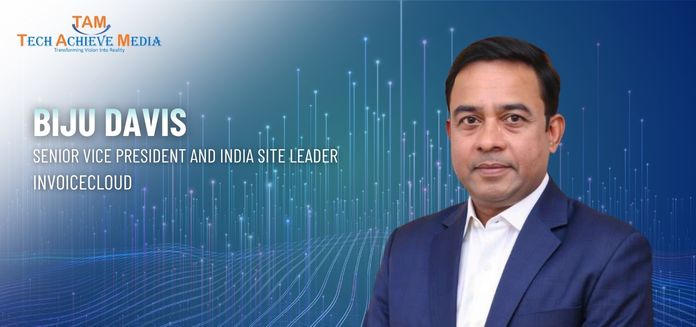
As Global Capability Centres (GCCs) evolve from cost-focused offshore operations into strategic innovation hubs, India has emerged as the preferred destination for building next-generation product engineering capabilities. Challenging the long-held perception that GCCs are driven primarily by cost arbitrage, InvoiceCloud believes India’s biggest advantage lies in the depth of its engineering talent and its ability to build globally relevant products. The US-based digital payment solutions provider established its Hyderabad Centre of Excellence two years ago and has since expanded it into a key contributor to the company’s global product roadmap. In this conversation with Tech Achieve Media, Biju Davis, Senior Vice President and India Site Leader, InvoiceCloud, shares why Hyderabad was chosen, how the India team has taken ownership of core product development, the company’s AI-first engineering strategy, and why he believes India’s GCC ecosystem is entering an entirely new phase.
TAM: InvoiceCloud established its India Centre of Excellence in Hyderabad at a time when the city was emerging as one of India’s leading GCC destinations. What made Hyderabad the right choice, and how has the India centre evolved over the past two years?
Biju Davis: InvoiceCloud has been operating in the US for more than 15 years. Following the company’s transition to private ownership under Vista Equity Partners in 2024, the decision was made to establish a Centre of Excellence in India. Vista already had a strong presence in the country through several portfolio companies, and that ecosystem helped us evaluate different cities before finally selecting Hyderabad. A combination of factors influenced the decision. Hyderabad offered a growing fintech talent ecosystem, strong infrastructure, and the advantage of being less saturated than some other technology hubs. Existing Vista companies operating successfully in the city also gave us confidence that Hyderabad could support our long-term growth.
We began with engineering and customer success as our initial focus areas. However, within six months, the quality of talent and the speed of execution exceeded expectations. That success encouraged several other global functions to establish teams here. Today, besides engineering, we have product management, customer success, professional services, InfoSec, infrastructure security and even go-to-market functions operating from Hyderabad. In just two years, the centre has grown to nearly 250 employees, with around 160 professionals working in product engineering and R&D. The increasing ratio of engineering talent in India compared to our headquarters clearly reflects the strategic value the India centre now delivers to the company’s overall product mission.
TAM: InvoiceCloud serves highly regulated industries including utilities, insurance and government. How does the India team balance rapid innovation with the security and compliance requirements that these industries demand?
Biju Davis: From day one, we never wanted separate engineering organisations in India and the US. Every engineering team is tightly integrated regardless of geography. Some scrum teams are fully based in India, while others operate as globally distributed teams. The confidence built through the early engineering successes meant that India quickly moved beyond supporting functions and began owning core product development. Whenever there has been expansion or organisational changes globally, more ownership has naturally shifted to India.
Importantly, cost was never the primary driver behind building the centre. Engineering talent today commands competitive salaries globally. The real advantage India offers is access to exceptional engineering capability. From the beginning, we ensured the India teams worked on customer-facing products rather than smaller maintenance tasks. Over the past year, our biggest focus has been Agentic AI and AI-powered customer experience innovations.
Security is built into every stage of development. Our InfoSec teams in India work closely with their US counterparts. Every engineering initiative begins with security guardrails, and every Agile user story incorporates both functional and non-functional security requirements before development begins. Security is foundational to how we build products, as opposed to being only an afterthought.
TAM: AI is transforming software engineering. Beyond the industry buzz, how is InvoiceCloud practically using AI across product development and internal operations?
Biju Davis: Like many organisations, we were initially cautious because early AI technologies came with challenges such as hallucinations. However, we also recognised very early that AI had to become part of every employee’s workflow. We invested in enterprise AI platforms including ChatGPT, Claude, Cursor and Devin. Before giving employees access, everyone underwent mandatory prompt engineering training. That ensured responsible and effective adoption.
Today, AI is deeply integrated into engineering. Every developer uses AI-assisted coding tools. Initial code generation, documentation, test cases and feature descriptions are increasingly AI-assisted. Adoption has now reached nearly 100 percent across engineering.
Our teams have reported a 30 to 40 percent improvement in engineering productivity. During our standard two-week sprint cycles, many teams now complete 70 to 80 percent of planned development within the first week, leaving additional time for validation, refinement and code quality improvements. AI extends well beyond engineering. Employees use AI for presentations, documentation and everyday communication. HR teams use AI agents that answer employee queries using internal company policies. AI is also helping modernise legacy code into newer technology stacks. On the product side, we’re building Agentic AI capabilities that directly improve customer experiences and ultimately help our clients increase operational efficiency and revenue.
TAM: Looking ahead, how do you see India’s role evolving in the global fintech and GCC ecosystem?
Biju Davis: The earliest GCCs in India primarily focused on banking back-office operations. Today, that model is changing significantly. Organisations are rethinking workforce expansion. Instead of simply hiring another hundred employees, companies are increasingly combining highly skilled engineers with AI agents that significantly improve productivity.
History shows us that every major technological revolution, from industrialisation to computing, created new opportunities rather than eliminating them. AI will follow a similar path by enabling people to accomplish far more than before. India has built an exceptional fintech ecosystem. Cities such as Hyderabad and Gurgaon have become important innovation hubs.
What we’re seeing today is the rise of specialised GCCs and micro GCCs. Instead of replicating entire organisations in India, companies are building focused centres dedicated to one strategic capability, whether that’s cybersecurity, AI engineering or a single next-generation product.
That represents the future of the GCC model.
TAM: Could you share some examples of the innovations currently being developed from the Hyderabad centre?
Biju Davis: InvoiceCloud operates an omnichannel payment platform serving billers such as utility providers, municipalities and government agencies. Our goal is to make payments frictionless for both the organisations issuing bills and the customers making payments. Unlike India, where digital payments have advanced rapidly through UPI, many payment processes in the US still rely heavily on credit cards, paper cheques and traditional payment mechanisms. Our AI initiatives focus on reducing friction throughout that payment journey.
For example, AI agents can proactively remind customers about upcoming payments while recommending the most convenient payment methods. Another major area is reconciliation. Every payment ecosystem must reconcile thousands of transactions involving partial payments, refunds, adjustments and multiple stakeholders. AI agents are helping automate and simplify these highly complex reconciliation processes. Our next phase involves predictive analytics, enabling customers to anticipate payment trends and improve operational decision-making. Some of these capabilities have already been deployed, while others remain under active development.
TAM: Finally, what broader trends do you believe will define the next phase of India’s GCC journey?
Biju Davis: One significant change is that GCCs are no longer limited to multinational corporations with tens of thousands of employees. Today, companies with fewer than a thousand employees globally are also establishing India centres because they recognise the value of India’s talent ecosystem. That reflects the growing trust global organisations now place in India.
I recently came across data showing that even Japanese companies, which have traditionally been highly conservative and quality-focused, have now established well over a hundred GCCs in India. Factors such as Japan’s ageing workforce are creating new opportunities for India. Looking ahead, one area that deserves greater attention is stronger collaboration between academia and industry. Universities need to prepare graduates with an AI-first mindset because that’s increasingly one of the key capabilities companies evaluate during campus hiring. I believe that’s where the next phase of India’s GCC evolution will be shaped.