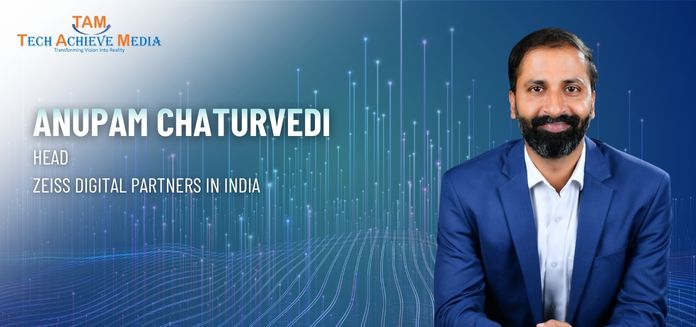
As enterprises move beyond experimentation with generative AI, the conversation is rapidly shifting toward agentic AI, which are systems capable of not only generating insights but also taking action. However, scaling AI from pilots to enterprise-wide adoption requires more than technology investments. It demands trusted data foundations, measurable business outcomes, strong governance and a workforce prepared to work alongside AI. In this exclusive interaction with Tech Achieve Media (TAM), Anupam Chaturvedi, Head of ZEISS Digital Partners in India, shares his perspective on the evolution from generative AI to agentic AI, the importance of data governance, practical AI use cases at ZEISS, and what it takes for organisations to become truly AI-first.
Also read: Inside ZEISS India’s Move from Reactive Service to Predictive Customer Support
TAM: Over the last few years, generative AI has moved from experimentation to mainstream business conversations. Now, the focus is increasingly shifting toward agentic AI. How do you see this transition changing the way modern organisations function?
Anupam Chaturvedi: Generative AI has already transformed how employees create content, access information and improve productivity. However, the next phase is agentic AI, which goes beyond generating responses and focuses on understanding goals, solving problems and taking actions within defined governance frameworks. These AI agents can interact across systems, understand business contexts and help deliver end-to-end outcomes rather than simply providing recommendations. In many ways, they function as digital teammates that collaborate with employees rather than just serving as assistants. As organisations deploy agentic AI across customer experience, operations and business functions, the impact will be significant. However, the effectiveness of these systems depends heavily on trusted data, governance models and strong semantic foundations. When those elements are in place, AI becomes a true business differentiator.
TAM: One of the biggest concerns organisations have is demonstrating return on investment. What is the secret to moving AI from a pilot project to a business-critical capability?
Anupam Chaturvedi: Many organisations struggle with what is often called “pilot paralysis.” The reason is simple, which is they focus on the technology first rather than the business problem. At ZEISS, we begin by identifying the business challenge and then determine how AI can help solve it. Every AI initiative is linked to measurable outcomes such as productivity improvements, operational efficiency gains, quality enhancements or customer impact. We establish clear metrics before implementation and continuously measure results. AI should never be deployed simply because it is the latest technology. It must be directly connected to business outcomes. Equally important is creating organisational confidence around governance, security and responsible usage. Scaling AI is not a sprint; it is a long-term transformation journey that requires patience, commitment and continuous improvement.
TAM: As AI agents become more common, employees will increasingly work alongside them. How can Indian enterprises prepare their workforce for this hybrid future?
Anupam Chaturvedi: This is fundamentally a leadership and culture challenge rather than a technology challenge. Many employees worry that AI could replace their jobs. Leaders must help them understand that AI is an enabler that allows people to focus on higher-value work involving critical thinking, decision-making and domain expertise. At ZEISS, we invest significantly in upskilling programmes, awareness initiatives and AI adoption platforms. Employees across functions, from IT and software development to finance, operations and HR, are given opportunities to learn and use AI tools in their daily work. Managers of the future will lead hybrid teams consisting of both humans and AI agents. Organisations must therefore focus on reskilling employees, redefining competencies and building a culture that embraces continuous learning and innovation.
TAM: ZEISS has invested heavily in becoming a global data custodian and building unified data environments. Why is this so important for successful AI adoption?
Anupam Chaturvedi: Trusted AI starts with trusted data. No AI model can consistently deliver reliable outcomes if the underlying data is fragmented, inaccurate or poorly governed. We recognised this several years ago and invested heavily in building strong data foundations. This involved creating governance frameworks, defining data ownership structures and establishing clear responsibilities for data quality across the organisation. We also built enterprise-wide data platforms that bring together information from finance, sales, marketing, R&D and other functions. By creating a unified, governed and secure data environment, we have been able to improve decision-making, enable predictive analytics and prepare the organisation for AI at scale. When AI systems have access to clean, reliable and contextualised data, they deliver significantly better outcomes and reduce risks such as hallucinations and inconsistent responses.
TAM: ZEISS GPT has emerged as an interesting internal AI initiative. Could you share some real-world examples of how it is improving day-to-day operations?
Anupam Chaturvedi: ZEISS GPT provides employees with a secure AI environment where they can build and use customised assistants without compromising enterprise data security.
One example is a facility management chatbot that helps employees quickly access information about workplace services and facilities. Similarly, HR assistants help employees find policy information, draft communications and resolve common queries without requiring manual intervention from HR teams.
We have also deployed AI-driven Site Reliability Engineering (SRE) agents that monitor applications, identify issues, perform root-cause analysis and recommend solutions. What previously required several hours, or even days, of investigation can now be accomplished in a fraction of the time.
Another example is procurement. We have developed agents that analyse vendor proposals, compare specifications, evaluate supplier credibility and generate structured assessments. This enables procurement teams to make informed decisions much faster while focusing their attention on the most relevant options. Today, we are working on 50 to 60 AI use cases spanning finance, operations, customer engagement, sales and marketing, and we continue to expand these initiatives.
TAM: Organisations once aspired to be cloud-first. Today, the ambition is to become AI-first. What advice would you offer CXOs looking to build AI-first enterprises?
Anupam Chaturvedi: There are four key priorities:
- First, AI initiatives must be tightly aligned with business strategy and measurable outcomes. AI cannot be treated as a standalone technology project.
- Second, organisations must focus on culture and workforce readiness. Employees need access to tools, training and opportunities to develop new skills. Leaders should also revisit competency frameworks because many roles are evolving in response to AI.
- Third, building strong data foundations is essential. Clean, trusted and governed data is the backbone of every successful AI initiative.
- Fourth, responsible AI practices must be embedded throughout the organisation. Governance, security and compliance are critical for maintaining trust among employees, customers and stakeholders.
- Finally, leaders should recognise that becoming AI-first is a long-term journey. Success requires consistency, patience and continuous learning. Organisations that remain focused on these fundamentals will be well positioned to realise the full potential of AI.