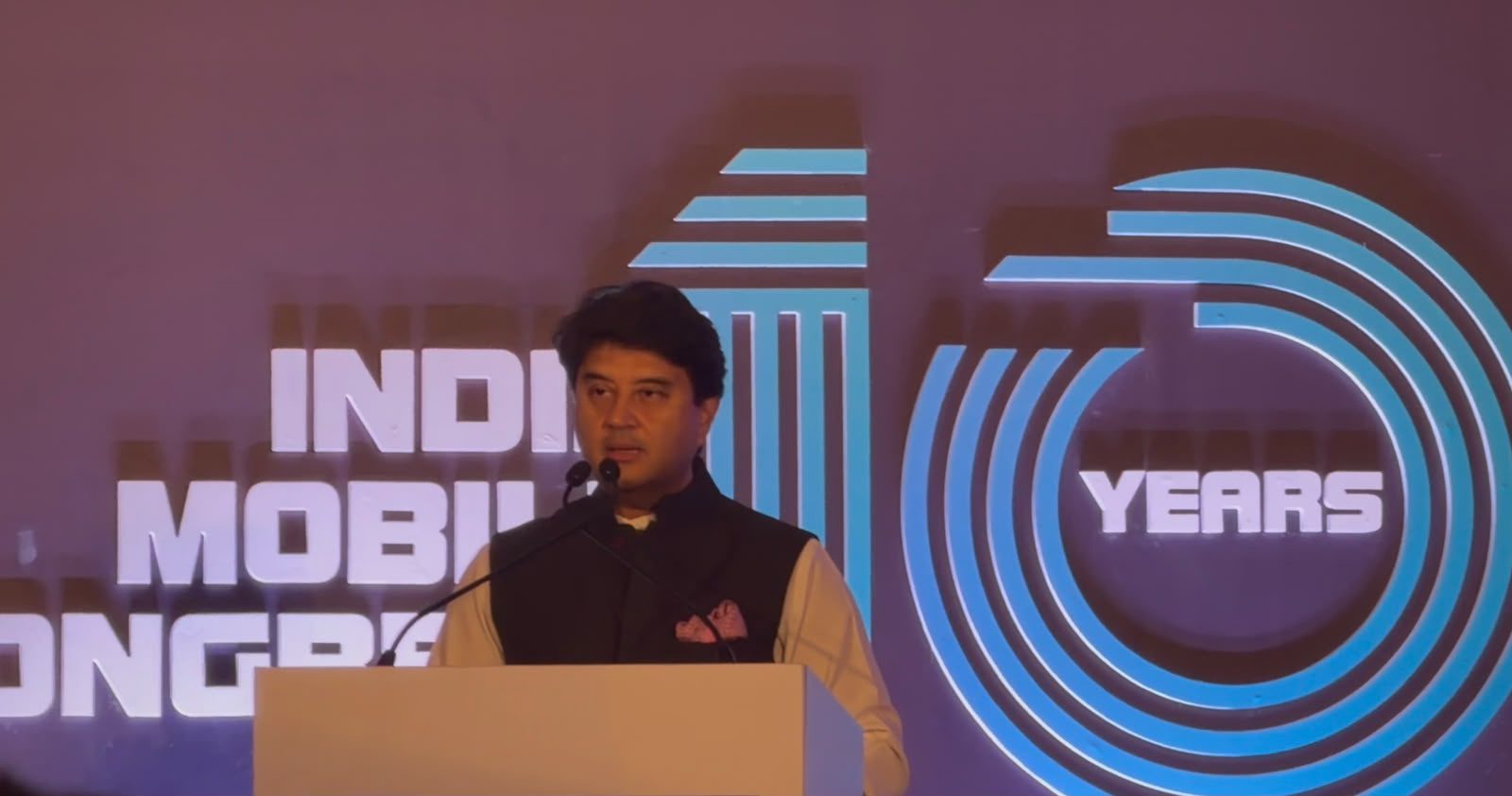
Setting the tone for the 10th edition of the India Mobile Congress (IMC) 2026, Jyotiraditya Scindia, Union Minister for Communications and Development of North Eastern Region outlined an ambitious vision for India’s digital future, calling on the telecom ecosystem to transform Indian innovation into global solutions under the theme “Scale Without Boundaries.”
Addressing industry leaders, policymakers, technology companies and global stakeholders at the IMC 2026 Theme Launch in New Delhi, Scindia said the Indian telecom sector has evolved from being a national success story into an international platform capable of shaping the future of global connectivity, digital inclusion and next-generation technologies. “The India Mobile Congress is no longer just an India event or a South Asian event. Today, it is an international platform, reflecting the collective achievements of India’s telecom ecosystem and its growing contribution to the world,” he said.
Digital India Built on Democratization and Inclusion
Scindia credited Prime Minister Narendra Modi’s Digital India vision for transforming the country’s digital landscape through two foundational principles namely the democratization of technology and Antyodaya, or empowering the last citizen. According to the Minister, technology achieves its true purpose only when it reaches every citizen and creates opportunities for inclusive growth. “When technology reaches every citizen, it creates opportunity. And when opportunity reaches every citizen, transformation happens,” he said.
Highlighting India’s digital achievements over the past decade, Scindia said the country today has 1.33 billion mobile subscribers, among the highest monthly mobile data consumption globally at nearly 27 GB per user, while witnessing a 97 percent reduction in data prices from Rs 287 per GB a decade ago to nearly Rs 8 per GB today. “This is democratization. This is Antyodaya,” he remarked.
Also read: Telecom Will Power India’s AI Future: COAI at India AI Impact Summit 2026
Scindia said the next phase of India’s telecom journey must focus on taking Indian innovations, technologies and ideas beyond national borders. “The thoughts I want to leave with the IMC today are that as we lay the foundation for the next chapter, we must examine how innovations from India, technology from India and ideas from India can cross borders and benefit societies across the world.”
He stressed that technology should never become an objective in itself but should remain an enabler of social and economic progress. “Technology is best not merely when it brings people together, but when it reaches every single citizen and benefits them. Technology should never be an end in itself. Instead, it must always be the means to the end.”
‘Scale Without Boundaries’ Reflects India’s Global Ambition
Explaining the significance of the IMC 2026 theme, “Scale Without Boundaries,” the Minister said it captures India’s ability to create technologies that transcend geographical limits while addressing global challenges. Drawing parallels with India’s historic contributions, from chess and yoga to ancient linguistic systems that inspire modern programming, Scindia said India has always demonstrated the ability to create knowledge that benefits humanity.
“India today has capabilities in the technologies we build, the standards we shape and the solutions we provide. ‘Scale Without Boundaries’ embodies the ability of government and industry together to create capabilities not only for India but for the entire world.” Tracing the evolution of telecommunications, Scindia explained how each generation of connectivity has expanded human capabilities. “With 2G we connected people. With 3G we delivered information. With 4G we built digital ecosystems. With 5G we enabled enterprise transformation. With 6G, I firmly believe we will seamlessly integrate the physical, digital and intelligence into one ecosystem.”
He noted that India’s responsibility now extends beyond deploying technology to ensuring it creates measurable impact on people’s lives. The Minister cited the government’s Samriddha Gram Village initiative, piloted in Uttar Pradesh, Andhra Pradesh and Madhya Pradesh, as an example of technology creating meaningful grassroots impact by delivering governance, banking and healthcare services digitally at village doorsteps. He also noted that the initiative recently received international recognition at the World Summit on the Information Society (WSIS), demonstrating India’s growing leadership in digital public innovation. “Technology is only as effective as its ability to improve the lives of every single citizen,” Scindia said.
Highlighting India’s rapid 5G deployment, the Minister said nearly 500 million people have already been connected within two-and-a-half years, supported by Rs 4.5 lakh crore in capital investment and nearly five lakh telecom towers. “Imagine connecting the equivalent of Europe’s entire population in record time. That is what India has achieved.”
He further announced the government’s target of connecting one billion citizens through 5G by 2030, positioning the technology as a catalyst for enterprise growth, innovation and digital inclusion. Sharing examples from the North-East, Scindia explained how telecom connectivity has enabled artisans, handloom weavers, handicraft manufacturers and horticulture farmers to directly access international markets. “Our job is to disintermediate the intermediary, to connect the artisan and the manufacturer directly with the market. That is the value the telecom ecosystem has created.”
Four Pillars of India’s Telecom Vision
Scindia said IMC 2026 would revolve around four strategic pillars namely Srishti (Innovation), Sashakt (Empowerment), Samvardhan (Growth), and Surakshan (Security). On innovation, he reiterated India’s ambition to become a global leader in 6G, noting that the Bharat 6G Alliance is already working across seven specialised groups to contribute to global standards through the ITU and 3GPP frameworks: “We followed the world in 4G. We marched with the world in 5G. But we will lead the world in 6G.”
On growth, the Minister highlighted the success of the government’s Production Linked Incentive (PLI) scheme for telecom manufacturing. According to Scindia, the scheme has already generated Rs 6,000 crore in investments, Rs 1.2 lakh crore in sales, Rs 25,600 crore in exports, and created over 36,000 jobs.
India to Launch First Telecom Manufacturing Zone
Announcing a major manufacturing initiative, Scindia revealed that India will establish its first Telecom Manufacturing Zone (TMZ) in Gwalior, Madhya Pradesh, creating an integrated ecosystem for telecom equipment, semiconductor manufacturing and data centres: ”You have heard about SEZs. Now the world will hear about TMZs, Telecom Manufacturing Zones dedicated entirely to the telecom sector.”
He said the initiative would strengthen India’s ambition to become a global telecom manufacturing hub while accelerating the country’s Atmanirbhar Bharat vision. Strengthening Digital Security On digital security, Scindia highlighted initiatives such as Sanchar Saathi, which has already crossed 2.5 crore downloads, helping citizens protect themselves against telecom fraud and strengthen digital sovereignty.
He also pointed to India’s new telecom regulations and increasing participation in global standards development as important milestones in building a secure digital ecosystem. Telecom Without Borders Concluding his address, Scindia described telecommunications as a sector uniquely positioned to unite humanity beyond geographical and political boundaries: “A radio wave knows no borders. A satellite beam carries no passport. Our sector alone teaches the world that humanity is fundamentally interconnected.”
Reaffirming the government’s commitment to building an Atmanirbhar Bharat and achieving the vision of Viksit Bharat, the Minister urged government, industry and innovators to work together in taking India’s digital capabilities to the global stage: ”As we launch the 10th edition of India Mobile Congress, let us build an ecosystem where knowledge knows no boundaries, partnerships are built on trust, and innovation serves every citizen across the world. India’s telecom journey has only just begun.”